
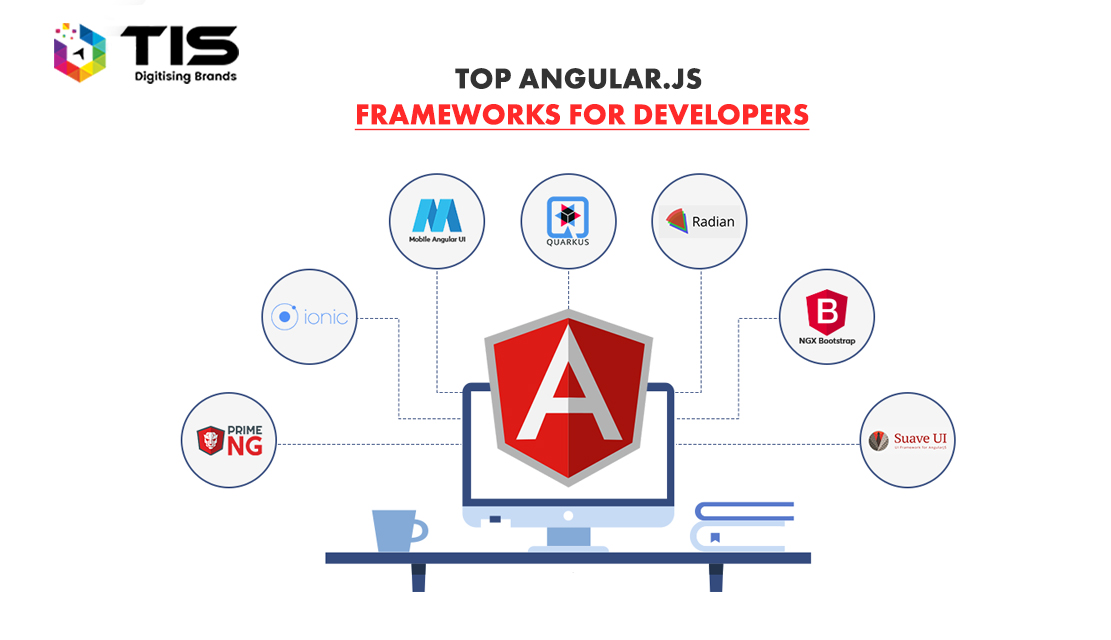
AngularJS shaped a generation of single-page applications, and even after Google officially ended its long-term support on December 31, 2021, the framework still powers business-critical software across finance, healthcare, and enterprise IT. According to HeroDevs post-EOL research, more than a million live sites continue to run on AngularJS. If your team maintains a legacy application, evaluates a migration path, or audits the UI libraries layered on top of it, knowing the ecosystem matters. This guide breaks down the ten most influential AngularJS frameworks, what each one is genuinely good for, and how to choose between them in 2026.
AngularJS frameworks are component libraries, UI kits, and structural toolsets built on top of the core AngularJS (1.x) framework. They reduce boilerplate, standardize design, and accelerate delivery for teams maintaining legacy SPAs or modernizing internal tools. The honest truth: no new greenfield project should start on AngularJS today. endoflife.date confirms AngularJS reached end-of-life with version 1.8.3, and unpatched CVEs continue to surface in the wild. But thousands of admin panels, intranets, and regulated-industry dashboards still depend on it, and the right framework choice affects security posture, migration cost, and developer productivity for as long as the application lives.
| Framework | Primary Use Case | Design System | Best Suited For |
|---|---|---|---|
| Angular Material | UI component library | Google Material | Enterprise dashboards |
| Mobile Angular UI | Responsive mobile UI | Bootstrap 3 | Hybrid mobile apps |
| Ionic | Hybrid mobile SDK | Custom + Material | Cross-platform apps |
| Angular UI Bootstrap | Bootstrap without jQuery | Bootstrap | Admin panels |
| UI Grid | Data grid component | Minimal | Data-heavy interfaces |
| LumX | Lightweight UI kit | Material + Sass | Visual web apps |
| Supersonic | Hybrid mobile UI | Native-like | Performance-first apps |
| Videogular | HTML5 video player | Custom | Media-driven sites |
| Suave UI | Lightweight UI directives | Custom | Internal tools |
| Radian | Data visualization | Plot-focused | Scientific dashboards |
Maintained by the Angular team at Google, Angular Material remains the most polished UI library in the AngularJS ecosystem. It ships more than 30 components, including data tables, date pickers, dialogs, and cards, built around Material Design principles. Teams reach for it when consistency, accessibility, and browser portability matter more than custom branding. For AngularJS 1.x projects, the legacy material package is still functional, but for any forward-looking work, the modern Angular Material package is the practical choice. It pairs naturally with enterprise dashboards, admin tools, and any interface where a familiar design language reduces user onboarding time.
Mobile Angular UI bridges Bootstrap 3 and AngularJS without bringing jQuery into the picture. It delivers the mobile primitives Bootstrap left out: switches, overlays, sidebars, scrollable areas, and fixed top and bottom navbars. The framework is lightweight, uses fastclick.js and overthrow.js under the hood, and converts an existing Bootstrap-based desktop app into a responsive mobile interface with minimal rework. Engineering teams maintaining legacy hybrid apps often keep Mobile Angular UI in place because rewriting mobile flows is rarely worth the disruption when the existing layer already works.
Ionic began as an AngularJS-first SDK for hybrid mobile apps and grew into a framework-agnostic platform that now supports Angular, React, and Vue. The original Ionic 1.x release remains relevant for legacy AngularJS apps shipping to iOS and Android through Cordova or Capacitor. Its strength is a deep library of mobile-optimized components, gestures, and animations that look native on both platforms. Teams considering Ionic today usually evaluate the modern version for new builds while keeping Ionic 1.x in maintenance mode for older codebases that still ship updates to enterprise users.
Bootstrap is one of the most widely deployed CSS frameworks on the web, but its native JavaScript components depend on jQuery, which clashes with AngularJS digest cycles. Angular UI Bootstrap rewrote the most useful Bootstrap components as pure AngularJS directives. The result is a familiar visual language with no jQuery dependency: dropdowns, modals, tooltips, popovers, carousels, accordions, and tabs that play cleanly with AngularJS scopes. It is one of the most common dependencies in legacy AngularJS admin panels and is still actively used in maintenance work, though the official repository is no longer in active development.
Originally released as ng-grid, UI Grid is a high-performance data grid written entirely in AngularJS with zero jQuery dependence. It handles the workloads developers actually struggle with: large datasets, grouping, sorting, filtering, exporting, column pinning, row virtualization, in-cell editing, and internationalization. For dashboards, ERP screens, financial back-office tools, and any interface where the table is the application, UI Grid still earns its place in legacy stacks. Migration teams often replace it last because the data interactions it abstracts are non-trivial to rebuild in modern frameworks.
LumX is a Material Design framework for AngularJS built with Sass, Bourbon, and Neat. It is lighter than Angular Material and gives front-end developers more freedom to customize the visual layer. Teams that wanted Material aesthetics without committing to the full Google component library reached for LumX, especially for marketing-adjacent web apps and product surfaces where visual differentiation matters. It also handles asset optimization automatically, which historically helped page-load performance on bandwidth-constrained markets.
Built by AppGyver on top of AngularJS, Supersonic targets hybrid mobile applications that need a native feel without going fully native. It bundles UI components, animations, and gestures tuned for mobile performance and supports both iOS and Android from a single codebase. Its real value shows up in apps where perceived performance matters more than pixel-perfect platform fidelity, including field-service tools, sales-enablement apps, and internal mobile workflows.
Videogular is an HTML5 video framework for AngularJS based on the MVVM pattern. It exposes a clean directive-based API for embedding, controlling, and styling video players, plus plugins for analytics, buffering, and overlays. For media-driven sites, learning platforms, and any product where video is the primary content, Videogular eliminates the friction of integrating a generic player into an AngularJS app. It remains a common dependency in legacy ed-tech and entertainment codebases.
Suave UI is a lightweight directive library that bundles CSS definitions, services, and UI primitives for web interfaces. Components arrive in pre-packaged bundles, which means developers do not stitch together individual imports for grids, layered elements, colored buttons, and form controls. It is rarely the headline choice for a public-facing product, but it shows up frequently in internal tools and back-office systems where speed of build outweighs visual ambition.
Radian, part of OpenBrain’s BayesHive project, is an open-source plotting library that embeds rich visualizations into HTML using AngularJS directives. It binds JavaScript variables directly to custom HTML elements, which makes interactive scientific charts and data-exploration interfaces dramatically easier to build than wiring a generic charting library into the AngularJS lifecycle. Research platforms, analytics dashboards, and scientific computing tools still lean on Radian for this reason.
Framework selection in 2026 is less about features and more about lifecycle strategy. Three questions sharpen the decision:
For teams running production AngularJS workloads, the safer long-term path is a phased migration to modern Angular, React, or Vue, often using ngUpgrade to run both frameworks side by side. Comparing Angular and React is a useful starting point when choosing the target stack.
Three patterns surface repeatedly in legacy AngularJS audits, and each one adds avoidable cost or risk:
TIS works with engineering teams on both sides of the AngularJS decision: securing and extending legacy applications, and planning incremental migrations to actively supported frameworks. Our AngularJS development services cover legacy maintenance, security hardening, and migration planning, while businesses that need dedicated talent can hire AngularJS developers on flexible engagement models. The goal is the same in either case: protect the investment already in production while creating a credible path to a modern stack.
Reasons to Use AngularJS Over Plain JavaScript
They remain relevant for teams maintaining legacy AngularJS applications, which still power a significant share of enterprise back-office systems, regulated dashboards, and internal tooling. For new projects, modern Angular, React, or Vue is the better choice because AngularJS itself is no longer officially supported by Google. Framework knowledge matters most during maintenance, security hardening, dependency auditing, and incremental migration to a supported stack, where the right legacy components ease transition.
AngularJS refers to the original 1.x framework released in 2010, written in JavaScript and based on the MVC pattern. Angular refers to the complete rewrite released in 2016, written in TypeScript with a component-based architecture, RxJS observables, and a different change detection model. They share branding but are fundamentally different frameworks, which is why migration between them requires re-engineering rather than a simple version upgrade or dependency bump.
Ionic is the most widely adopted choice for hybrid mobile apps built on AngularJS, with Mobile Angular UI and Supersonic as strong alternatives depending on project constraints. Ionic offers the deepest component library and the smoothest path to modern versions if you later migrate to React or Vue. Mobile Angular UI suits lightweight Bootstrap-based projects, while Supersonic prioritizes native-like performance on resource-constrained devices and older Android handsets.
It can be, with active mitigation in place. Since AngularJS no longer receives official security patches, teams should continuously monitor for new CVEs, restrict third-party dependencies, lock down templating inputs, and consider commercial extended support such as HeroDevs Never-Ending Support. The safer long-term strategy is a phased migration to a supported framework, especially for applications handling regulated, financial, or personally identifiable data subject to compliance frameworks.
Angular Material combined with UI Grid is the most common pairing for enterprise dashboards built on AngularJS. Angular Material standardizes the visual layer with accessible, well-tested components, while UI Grid handles complex data interactions like sorting, filtering, in-cell editing, and large-dataset virtualization. Angular UI Bootstrap is often added alongside them for familiar Bootstrap-based controls and dropdowns without the jQuery dependency that traditionally conflicts with AngularJS digest cycles.
Yes, planning should begin immediately even if execution is phased over multiple quarters. Security exposure grows every quarter the application stays on an unsupported framework, the developer pool for AngularJS continues to shrink, and compliance audits increasingly flag end-of-life dependencies. A staged migration using ngUpgrade, or a parallel rebuild for high-risk modules, lets teams protect business continuity while gradually moving toward a supported, modern architecture and reducing total cost of ownership.

© 2026 TIS. All rights reserved.