
Your marketing team adopted AI tools six months ago. Keyword research takes minutes, not hours. Ad copy is automatically generated. Social calendars fill up. Yet your competitors are always using identical AI platforms to outperform your campaigns. Productivity improvements are hollow with rising conversion costs and flat-line visibility. There is something fundamental between AI-assisted marketing, though, and AI-mastered strategy.
Artificial intelligence isn’t about automating existing workflows – it’s about radically changing the ways search engines rank content, advertising systems spend budgets, and social platforms decide who to show ads to. Organizations that adopted AI as a productivity multiplier find out too late that the competitive battlefield had completely changed. By 2026, it is not whether your team is using AI tools, it is whether your strategy takes into consideration how AI platforms now evaluate, rank and monetize marketing efforts across interconnected channels.
Half of business decision-makers now go to AI chatbots rather than traditional search engines to do initial vendor research – behaviour that increased 71% in just four months. When gathering recommendations from ChatGPT or Perplexity, you won’t know what your Google ranking means if AI systems don’t mention your brand name when generating answers.
This brings about double requirements. Traditional SEO foundations, such as technical performance, crawlability, structured data, backlinks from authoritative websites, etc., remain essential because AI platforms use search indexes as a major source for retrieving information. Without good traditional rankings, AI systems can’t find content to be cited. But ranking alone proves inadequate.
AI platforms favor content that is structured in a way that is easy to extract. Dense narrative prose, even when expertly optimized, has parsing challenges, reducing citation probability. Content that answers specific questions via scannable formats, comparison tables, FAQ sections, and labelled feature lists enables AI systems to extract information for synthesized answers.
Semantic Optimization over keyword targeting. Modern search algorithms driven by Google’s BERT and RankBrain-based machines understand the intention of the query instead of matching isolated keywords. Content has to show deep topical authority with concepts, the relation of entities, and the depth of context.
Authority signals were beyond backlinks. Mentions in trusted publications, engagement in speaking at conferences and reviews on established platforms are the focus of increasing importance by AI platforms. Digital PR and thought leadership become SEO tactics and are no longer separate.
Zero-click search forces measurement evolution. AI Overviews give full information without having to click. Top-ranking results lose up to 45% of traffic with the introduction of AI summaries. Organisations need to monitor metrics of AI visibility – brand mention frequency, context accuracy of citation, and competitive positioning – along with traditional metrics.
Professional SEO services have to incorporate both traditional optimization and structuring associated with AI. Organizations that do not have in place the resources to systematically monitor AI’s visibility are at risk of becoming progressively invisible as search behavior moves towards AI-assisted discovery.
Paid search went through a dramatic transformation as artificial intelligence systems took over the management of bids, targeting audiences and optimizing creatives. Google’s Performance Max, AI Max for Search and Demand Gen campaigns went from being optional enhancements to being fundamental.
Performance Max is a good example of the shift. These automated campaigns allocate spend across Search, Shopping, YouTube, Discover, Gmail, and Display at the same time with machine learning to determine converting segments and optimal placements. Advertisers in using Performance Max with flexible ROAS targets for 18% increases in converting query categories and 19% conversational lifts.
The effectiveness of automation totally relies on the quality of data. AI bidding algorithms are optimised against objectives set by conversion tracking, audience signals, and delivered creative assets. Organizations feeding clean first-party data, comprehensive catalogs and creative variations in abundance massively outperform those expecting AI to make up for poor inputs.
Creative automation is an opportunity and a risk. AI tools generate variations of ad copy, headlines and video content from text prompts or images. Generating Video without Production Resources- Google’s Veo and Imagen models. However, auto-created assets create brand safety issues. AI does not produce strategically aligned messaging, but rather it produces content that is likely to be produced. Organizations must juggle between efficiency and brand control.
The strategic implications vary with the size of organization. Large-scale enterprise organizations with strong data infrastructure often get better results from hybrid models that combine automation and manual control. Smaller organizations take advantage of automation dealing with the complexity they couldn’t manage by any other means.
Social platform advertising saw similar AI technology integration. Facebook’s advantage was campaigns, LinkedIn’s artificial intelligence capability creation, and TikTok’s automated optimization changed audience reach. Transformation is not only about automating bids, but it can also be about automating creative generation, audience discovery, and cross-platform coordination.
AI-powered audience targeting identifies the conversion-likely users based on behavioral patterns that are being missed by traditional demographic segmentation. Platforms analyze the usage of the device, engagement with content, purchase time and interaction sequences in order to predict conversion probability.
Creative automation creates variations that are appropriate to the platform. AI adjusts messaging, visual formatting and call to action phrasing across Instagram Stories versus Facebook Feed, and LinkedIn Sponsored Content – knowing that identical creative will perform differently in different contexts.
User-generated content and influencer marketing acquired algorithmic preference. AI is aware that social users react more favorably to unscripted peer content than polished brand advertising. Organizations that incorporate elements of UGC, testimonials and influencer partnerships are more successful in terms of engagement.
Video format dominance was accelerated. Research confirms that 78% of consumers prefer to learn about products via short-form video; as a result, Reels, TikTok Clips and YouTube Shorts are essential. AI tools to create a video from images democratized access, but strategic planning is still human-dependent.
Cross-platform coordination became a necessity of business. Attention of consumers is fragmented across platforms, with the purchase journey including discovery on one, research on another, and conversion on a third. Professional digital marketing services demand integrated approaches, coordinating message consistency, audience sequencing and attribution across fragmented touchpoints.
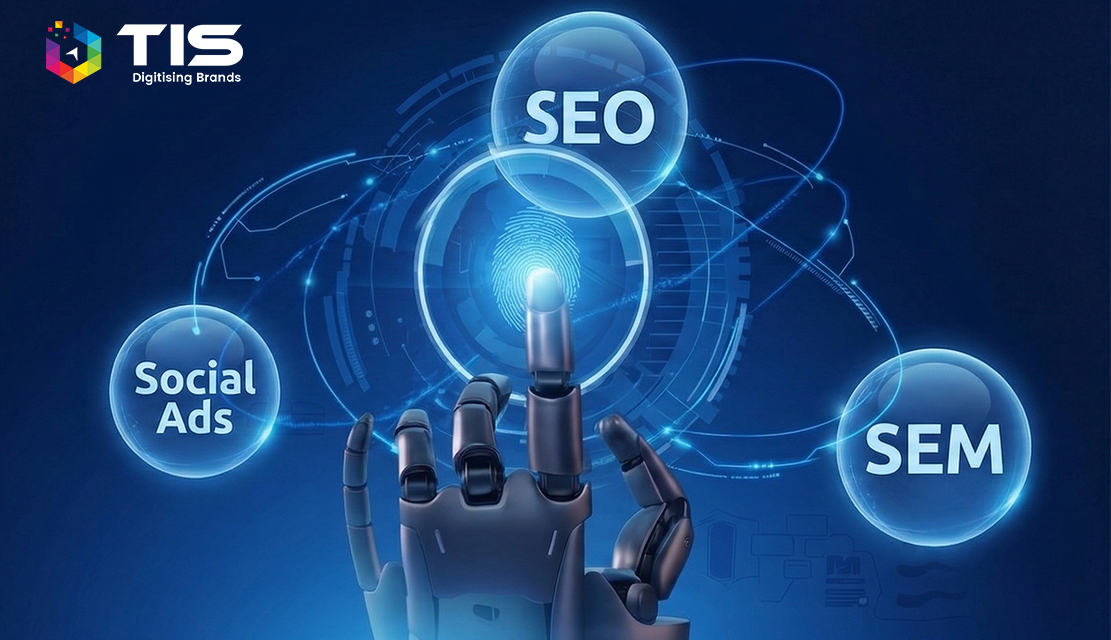
To be successful, it is necessary to understand that SEO, SEM, and social advertising no longer exist separately. AI platforms behind each discipline draw from the same sources of data, strengthen signals and assess brands holistically.
Social content communicates with the visibility of AI search. Posts, reviews and discussions from Reddit and LinkedIn are used as source material for ChatGPT and Perplexity responses. Active social presence enhances the effective probability of citation. Strong SEO rankings make social advertising more effective as algorithms of credibility factor in delivery.
Paid search data improves the organic optimization. SEM conversion data shows which queries are leading to business results and not traffic. These things give us an idea of priorities for organic content, targeting SEO efforts on commercial intent topics. High-quality organics saves you on paid costs since Quality Score rewards matching landing pages.
First-party data was connective tissue. As the disappearance of third-party cookies, along with privacy laws restricting tracking, happens, directly collected customer data becomes disproportionately valuable. Organizations systematically capturing emails, purchase history and engagement patterns deploy this in all domains.
Measurement frameworks have to span channels. Traditional metrics that evaluate channels independently fail to capture the power of AI-optimized marketing. Attribution modelling that accounts for multi-touch journeys, brand awareness increases from AI citations, and lifetime value improvement gives an accurate assessment.
Organizations transforming have capability needs beyond the adoption of tools. AI mastery requires technical infrastructure, data discipline, strategic oversight and creative differentiation.
The quality of the data affects the effectiveness of AI. Conversion tracking accuracy, customer data hygiene, catalog completeness, etc., directly affects optimization. Organizations need to invest in measurement infrastructure to ensure clean and reliable data to these algorithms.
Strategic control is a preventative measure for algorithm drift. While AI takes care of tactical optimization, human supervision makes sure systems are focused on achieving business goals and not just proxy metrics. Organizations require predetermined objectives, budget guidelines and creative boundaries that keep AI within strategic boundaries.
Creative differentiation is more important, and not less. As AI democratizes generation and optimization, competitive advantage comes from unique brand perspectives, proprietary insights and authentic storytelling AI can amplify but not originate.
Continuous adaptation proves to be essential. AI platforms develop fast, with major releases every 3 months. Organizations need to have learning cultures and flexible strategies with adaptability of capabilities as they mature.
Artificial intelligence turned digital marketing from channels that needed to be controlled to marketing that is now an interconnected ecosystem where algorithms take over execution while strategy drives results. Organizations that look at AI as a productivity tool find marginal gains. The transformational improvement for those redesigning their strategies around the way AI platforms look at content, how they allocate budgets, and how they reach audiences.
The way forward is to think in an integrated way. Strong SEO provides AI systems with content citations and lower paid costs. Paid campaign data is used to inform organic priorities. Social presence helps to enhance the visibility of AI searches. Success is derived from orchestrating interconnected effects.
AI capabilities that are reshaping the approach to digital marketing are early stages of the evolution that has been unfolding for ten years. Companies building systems to facilitate learning are positioning themselves to dominate when the platforms are mature. Those who accept existing tools as endpoints risk disadvantage.
The question that confronts marketing leaders: Is your organization taking an incremental approach to AI that focuses on efficiency, or is it approaching AI in a strategic way that leads to transformation? The difference between these approaches determines which organizations are leaders of their categories.
How is AI changing traditional SEO strategies in 2026?
AI changes SEO by two dual needs: optimization in the traditional sense, ensuring AI platforms find content and then AI specific structuring that makes content extractable for citations. Organizations need to optimize on both Page 1 rankings and AI visibility. Zero-click searches require measurement evolution to go beyond traffic to brand mention frequency
What’s the biggest mistake organizations make with AI-powered PPC campaigns?
Expecting AI automation to compensate for poor data quality. Performance Max campaigns optimize based on the accuracy of the tracking of conversions and asset variations provided. To be successful, it’s important to invest in the measurement infrastructure, first-party data collection, and strategic guardrails before deploying any automation.
Should businesses use AI-generated content for ads and social media?
AI-generated content is best used as starting points that need to be refined by humans. Platforms reward content that is real and is driving engagement over generic messaging. Be able to use AI for ideation and scale, but keep humans in on the strategic messaging. Most marketers check on AI content before publishing.
How do first-party data and privacy regulations affect AI marketing?
Third-party cookie deprecation makes first-party data incredibly more valuable. Organizations who focus on systematically collecting emails, buying history and engagement patterns receive competitive advantages in SEO, SEM and social advertising.
What metrics should replace traditional KPIs in AI-optimized marketing?
Traditional metrics are still relevant but need to be supplemented. For SEO, measure the frequency of brand mentions in AI answers. For PPC, measure conversion efficiency (across automated channels). Implement attribution modelling that includes multi-touch journeys.
How quickly should organizations adopt AI automation?
The urgency of adoption is based on capability maturity. Organizations with a good data infrastructure can deploy aggressively. Those who do not have capabilities should focus on the quality of data first. Delay is risky because the difference between the AI-optimized and traditional campaigns widens month-to-month.
 C - 81C, Sector - 8, Noida 201301, India
  info@tisindia.com
  (+91) 9811747579
1025 Beamon Drive, Franklin 37064 Tennessee, USA
info@tisindia.com
+1 424 283 4688
Sveavagen 34 111 34 Stockholm, Sweden
info@tisindia.com
A-10, Sahastradhara Rd, Doon IT Park, Dehradun, Uttarakhand
info@tisindia.com
(+91) 9811747579
(+91) 9811747579
1025 Beamon Drive, Franklin 37064 Tennessee, USA
info@tisindia.com
+1 424 283 4688
Sveavagen 34 111 34 Stockholm, Sweden
info@tisindia.com
A-10, Sahastradhara Rd, Doon IT Park, Dehradun, Uttarakhand
info@tisindia.com
(+91) 9811747579 
© 2026 TIS. All rights reserved.