
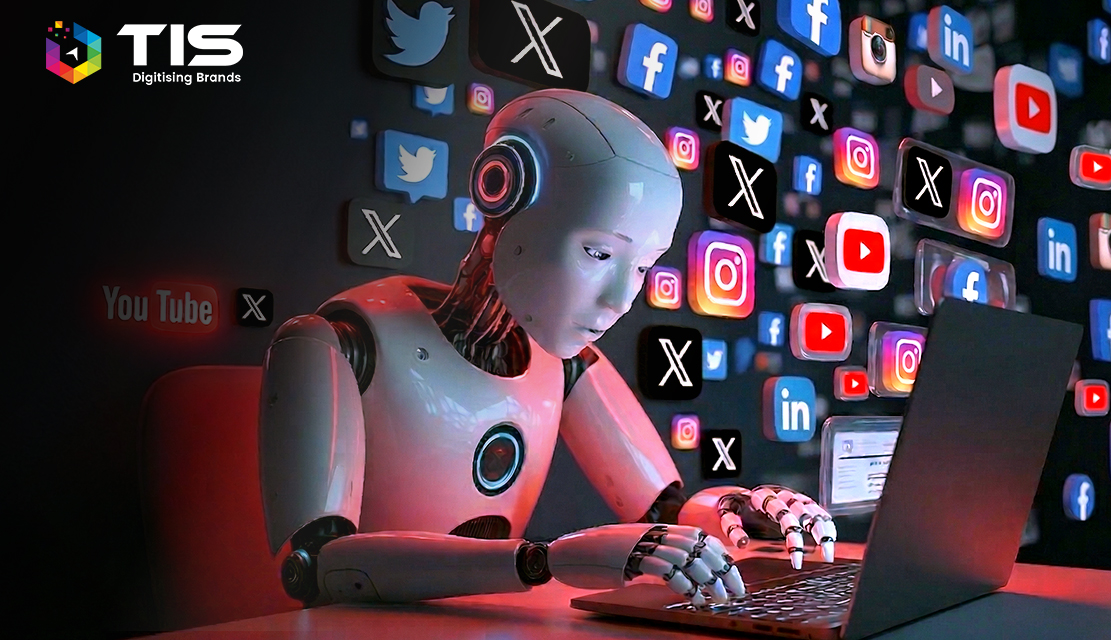
Social feeds have become noisy, fast, and unforgiving. A post that worked last month may not earn a second look this week. Algorithms shift, audiences scroll faster, and every brand competes for the same thin slice of attention. AI is what now separates teams that scale this complexity from teams that stall. It studies behaviour, sharpens targeting, and removes the guesswork that used to drain social budgets. For brands, the question is no longer if AI belongs in social marketing. It is how to apply it in ways that protect brand voice, lift performance, and convert attention into measurable revenue.
AI in social media marketing is the use of machine learning, natural language processing, and generative models to plan, produce, distribute, and measure social content. It is not one tool. It is a layer of intelligence that sits across listening platforms, ad managers, creative suites, and analytics dashboards. The goal is simple. Move faster, learn from every signal, and stop relying on instinct alone.
Brands now use AI to:
According to Sprout Social’s 2026 social media statistics, 73% of consumers will switch to a competitor if a brand fails to respond on social. AI is how modern teams keep up with that expectation at scale.
Smarter does not mean automated for the sake of automation. It means each step of the social workflow uses data to make better choices, faster. Here is how that plays out in practice.
Traditional segmentation grouped people by age, gender, and location. AI groups them by behaviour. It studies watch time, scroll depth, save rates, and comment tone, then builds clusters that reflect intent. A skincare brand can separate first-time researchers from repeat buyers and serve each group different creative on the same day. The result is fewer wasted impressions and a clearer path from feed to checkout.
Short-form video, carousels, and live formats demand a steady output. Generative AI helps teams brief, draft, and resize creative across formats without expanding headcount. 94% of marketers plan to use AI in their content creation workflows in 2026, and the gains show up in time to publish, not just volume. Teams ship more variants, test more hooks, and learn faster from each post.
AI models score creative against historical performance, audience signals, and platform trends. Marketers see expected click rates, save rates, and conversion likelihood before the ad goes live. Underperforming concepts get killed early. Strong concepts get more budget faster.
Natural language processing reads the tone behind every mention, review, and comment. Brands catch a complaint at hour one instead of day three. They spot a meme forming around their category and join the conversation while it still matters. Listening, once a monthly report, is now a live stream of signals.
Meta, TikTok, Google, and LinkedIn all now ship AI-driven ad systems that handle creative selection, audience expansion, and budget pacing. The marketer’s job shifts from manual tuning to setting the right inputs: clean creative, clear objectives, and trustworthy first-party data.
AI agents handle the repeatable layer of inbound messages. They classify intent, draft replies, and route complex issues to human moderators with full context. Response times drop, and humans focus on the conversations that actually need empathy and judgement. The brands that combine automated triage with trained moderators win on both speed and trust, which is where social customer care has always been decided.
AI now drives influencer discovery, fraud detection, and performance prediction. Instead of choosing creators by follower count alone, brands score them on audience overlap, engagement quality, content fit, and historical conversion patterns. This shifts spend away from inflated reach and toward partnerships that produce measurable returns, which is the metric most boards care about when they review creator budgets.
| Workflow Area | Traditional Approach | AI-Driven Approach |
|---|---|---|
| Audience targeting | Broad demographics, fixed personas | Behaviour-based micro-segments updated in real time |
| Content creation | Manual drafting, single variant per post | Multiple variants generated and tested per audience |
| Posting schedule | Set by team availability and gut feel | Optimised by engagement patterns per platform |
| Ad optimisation | Manual bid and creative changes weekly | Continuous, automated creative and budget shifts |
| Listening and sentiment | Monthly reports, keyword tracking | Live sentiment, intent detection, and trend alerts |
| Customer response | Queue-based, slow during off hours | Triaged in seconds, escalated when context demands |
| Reporting | Static dashboards, lagging metrics | Predictive insights tied to revenue signals |
The brands earning the most from AI in social are not the ones automating everything. They are the ones picking the right workflows to amplify. A few patterns stand out:
Hootsuite’s 2026 Social Media Trends report notes that consumers are increasingly cautious about overly polished, AI-styled content. The lesson is not to slow down AI use. It is to keep human judgement on the creative output so that posts still feel real.
Smarter marketing comes with new responsibilities. Brands that rush past these usually pay for it later.
Brands do not need a full transformation programme to benefit from AI in social. A phased approach works better.
For brands that want senior, hands-on support across strategy, content production, listening, and paid performance, TIS offers social media marketing services and AI-powered content creation services built for this hybrid human and AI model.
The next phase is agentic. AI systems will not only suggest the next post. They will plan a week of content, propose budget shifts, draft responses, and flag risks, all inside one workflow. Human marketers will move further up the value chain, focusing on brand storytelling, partnerships, and the cultural calls that algorithms cannot make. Expect tighter integration between social, CRM, and commerce data, where a single signal in a comment thread can trigger a creative test, a personalised offer, or an updated audience model. Platforms will reward brands that treat social as a connected revenue channel, not a standalone awareness play. The brands that adapt early will own attention. The ones that wait will keep paying more for less of it.
AI is not replacing social media marketers. It is removing the manual friction that has held social teams back for years. Smarter targeting, faster content, sharper listening, and steadier customer care now sit within reach of any brand that commits to a clear strategy. The brands that pair AI capacity with human creativity will define what good looks like in the next phase of social. Treat AI as a force multiplier, protect your brand voice, invest in the right team training, and measure against outcomes that matter to the business. That is how social media marketing becomes truly smarter, and how brands turn attention into long-term commercial value.
Related article: What Makes a Social Media Marketing Campaign Viral
AI makes social media marketing smarter by turning raw audience data into clear decisions. It studies behaviour across platforms, predicts which creative will perform best, schedules posts at peak engagement windows, and reads sentiment in real time. Brands move from guesswork to data-led choices, which lifts engagement, reduces wasted ad spend, and helps teams respond to customers faster without expanding headcount.
Start with high-volume, repeatable tasks where speed matters more than nuance. Strong first picks include drafting caption variants, generating creative for A/B tests, scheduling posts at optimal times, triaging comments and DMs, and running social listening for sentiment shifts. Keep brand strategy, sensitive replies, and final creative approvals with humans, so authenticity and editorial judgement remain intact across the workflow and audiences continue to feel a real voice.
Yes. AI lowers the cost of doing professional social marketing at scale. Small brands can use affordable tools to produce more creative, test ideas quickly, and respond to customers around the clock. They no longer need a large team to compete on quality. The advantage shifts to brands that combine AI speed with a clear positioning and a recognisable, consistent voice.
It can, when overused or unedited. Audiences increasingly recognise generic AI copy and overly polished visuals, and many become more cautious about brands that lean too heavily on them. The fix is editorial oversight. Use AI for drafts, structure, and creative variants, then let writers and designers add voice, context, and judgement. Disclose AI-generated content where required by platforms or regional regulations, and your brand will keep trust.
Look beyond vanity metrics. Track cost per acquisition, conversion rate from social, response time on inbound messages, share of voice, and sentiment trend over time. Compare creative variants by engagement rate and save rate. Measure how quickly campaigns move from brief to launch. When these numbers improve in parallel, AI is doing its job and freeing the team for higher-value strategic work.

© 2026 TIS. All rights reserved.