
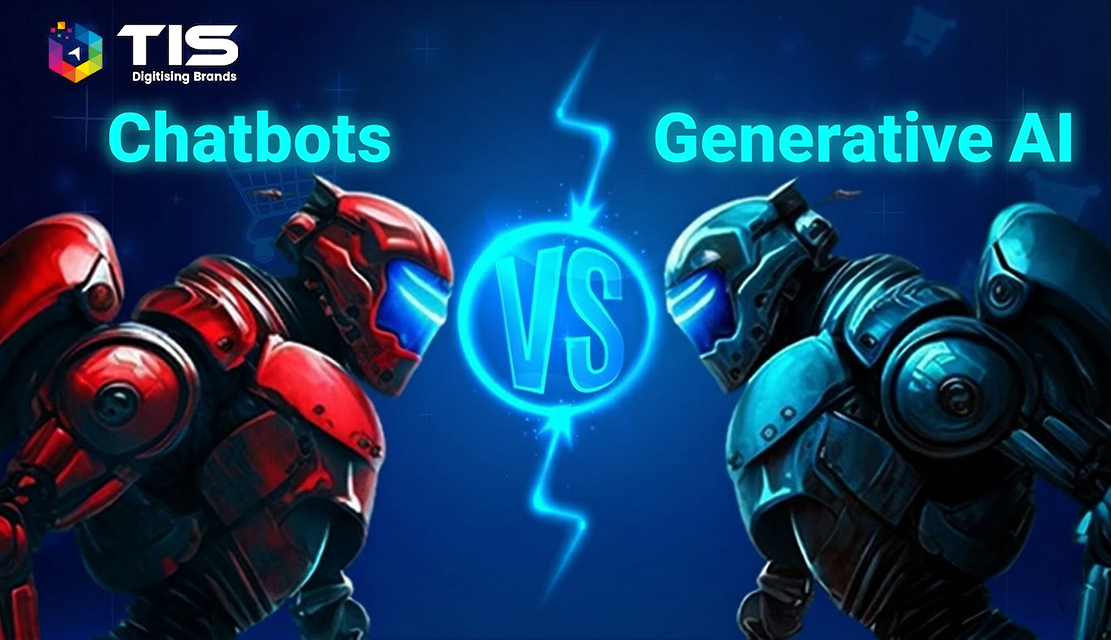
The customer sends a message at 2 AM inquiring about product compatibility. Your system responds instantly, understands the nuanced query and gives a contextually relevant answer that leads to a purchase. That interaction could have been driven by either a traditional chatbot or generative AI – and depending on the technology you choose means the difference between spending thousands of dollars managing that capability or tens of thousands, whether the conversation was scripted or natural, and whether your customer converted or abandoned their cart in frustration.
For CTOs and eCommerce leaders considering investments in conversational AI, this isn’t an academic question of technological sophistication. It’s a business decision with implications for customer experience, operational costs, development timelines and competitive positioning. The rush to generative AI has left the perception that traditional chatbots are obsolete, but operational reality is more complicated. Understanding when each approach is appropriate to your business goals requires that you look beyond marketing promises and look at actual requirements for implementation, cost structures, and use cases.
Traditional chatbots work on rule-based logic and decision trees. They recognise certain keywords or phrases and respond to them with predetermined answers in predetermined conversational paths. When a customer asks, “What are your shipping options?” the bot matches that query with a stored response script and sends the programmed answer. The interaction is mechanical because it is mechanical – every response is in a database waiting to be triggered by the right input pattern.
Generative AI fundamentally alters this architecture. These systems use large language models which are trained on massive datasets in order to understand natural language, interpret intent and generate original responses in real-time. When responding to the same question for shipping, generative AI takes into account the context of the conversation, customer history if available and produces an answer specific to that particular question instead of pulling from a static script. The technology knows how to handle variations and follow-up questions and adapts to the flow of conversation.
This distinction makes a difference in performance that is important to customer experience.
Where Traditional Chatbots Excel
Despite the shortcomings of their technology, rule-based chatbots help solve specific e-commerce problems in a very efficient and cost-effective manner. For businesses with simple customer service requirements, predictable patterns of inquiry, and clear response parameters, traditional implementations provide effective function without the complexity and cost of generative systems.
Take order status enquiries into account. A customer wants to know where the package is. The interaction involves extracting certain information from your order management system and displaying it in a clear way. A traditional chatbot does this perfectly – it knows the pattern of the query, uses API integration to get the relevant information about the order and shows the details of tracking. No natural language generation needed, no ambiguity to resolve, no need for understanding of context beyond basic intent recognition.
Traditional chatbots are also more advanced in controlling brand voice and messaging correctness. Every response is pre-written, reviewed and approved by your team. You decide on the precise formulation of phrases, and you ensure conformity to policy and hence communication standards. For regulated industries or brands with strict messaging requirements, this level of control reduces risk. You know exactly what that bot is going to say in any situation because you scripted all of the possibilities.
The cost structure is in favour of traditional implementations for budget-conscious businesses. Development includes defining conversation flows, scripting responses and integrating with existing systems – work that requires technical expertise, but not specialised AI infrastructure. There are still minimal ongoing operational costs. You’re not paying for language model API calls, constant model training, or the computational resources generative systems require. For startups and small to medium-sized eCommerce operations, this economic reality tends to trump the conversational sophistication that generative AI offers.
Generative AI is strategically needed when the complexity of the conversation, personalisation needs, or customer experience expectations cannot be met by rule-based systems. The technology is capable of solving problems that traditional chatbots cannot solve and creating capabilities that fundamentally change the way your customers interact with your eCommerce platform.
Product discovery is generative AI’s greatest eCommerce application. A customer isn’t sure what they want – they describe their preferences, they ask questions about use cases, and they need guidance to navigate through your catalogue. Traditional chatbots have customers trapped in predetermined search paths. Generative AI takes part in real discovery conversations, comprehending unclear requirements such as “I need a gift for someone who likes cooking but isn’t professional” and translating it to relevant product recommendations with natural explanations.
The depth of personalisation accomplished by the generative systems has the effect of repeating customer experiences. These implementations can reference purchase history, understand complex evolving preferences and maintain the context of a conversation across sessions. A returning customer with the question “Do you have more like that sweater I bought last month?” gets a response that actually understands the reference and, moreover, remembers the particular product and offers genuinely similar things. Traditional chatbots do not have the contextual memory and natural language understanding capabilities to deal with such nuanced interactions.
Complex customer service situations need the flexibility that generative AI offers. A customer has an issue that doesn’t fit any predefined category – maybe he or she received the wrong size in a bundle order and wants to exchange one item, but keep the others. Traditional chatbots fail here because the scenario is out of the capacity of their decision tree. Generative AI knows what the problem is, what the solutions are to it, and it can guide the customer in resolving it, even if it is not a common problem or one you have programmed solutions for specifically.
Your best bet is determined by business variables that are special to your business, which dictate how serious the limitations of traditional chatbots are or how sophisticated the generative AI is considered to be, as unnecessary overhead.
Evaluate your product catalogue complexity and customer inquiry patterns. If you are selling relatively simple products with predictable questions – e.g., order status, shipping policies, return procedures – then traditional chatbots do a good job of handling the majority of their interactions. If your catalogue involves in-depth product comparison, compatibility checking, or personalised product recommendation based on use case rather than basic filters, generative AI is worth the investment.
Customer service sophistication requirements should be considered. And how much of your support volume deals with unique situations that need to be understood in context and create custom solutions? If most of the inquiries will fall into established categories with typical resolutions, then scripted answers are adequate. If you are doing a lot of work with edge cases, subtle issues or situations where you need to apply judgment, generative capabilities are needed to prevent you from constantly handing things over to humans.
Budget realities aren’t limited to the initial cost of development but also include operational costs. Traditional chatbots have very low incremental costs – mostly maintenance and the occasional script update. Generative AI implementations are a source of API usage per interaction, constant monitoring of responses to ensure quality, and possible periodic retraining of the model. For high-traffic e-commerce websites, these operational costs add up rapidly and have to be factored into return on investment calculations.
Technology selection is only one component of the conversational AI decision. Successful implementation involves dealing with integration complexity, team capability requirements, and measurement frameworks to link conversational interactions to business results.
Integration depth, as it is the depth of integration that determines whether your conversational system adds real value to your – or if it is just another way to communicate. Both traditional and generative approaches require connectivity to your order management system, inventory database, CRM and possibly other enterprise systems. Working with an experienced e-commerce website development agency in India ensures these integrations maintain data accuracy, handle edge cases appropriately, and perform under high transaction volume.
Working with an experienced e-commerce web development agency in India ensures that these integrations keep data accurate, integrate edge cases effectively and also perform under high transaction volume.
Team expertise requirements vary considerably from approach to approach. Traditional chatbots require developers who possess knowledge of how to design a flow of conversation and integrate systems. Generative AI means new requirements in terms of prompt engineering, monitoring the quality of responses, and continuously refining them based on the analysis of interactions. If your team lacks these capabilities, partnering with specialists in e-commerce web development services who understand both the technical architecture and e-commerce business logic accelerates deployment and reduces implementation risk.
Measurement frameworks must link conversion metrics to real business results. Don’t just be concerned with message volume and response times. Measure conversion impact: Do conversations drive sales? Calculate support cost savings–how many inquiries are resolved in a human-free environment? Assess customer satisfaction directly and indirectly from feedback and behaviour indicators such as repeat interaction rates and post-conversation purchase behaviour. These are the metrics that will help determine whether your investment in conversational skills will provide you with ROI, no matter what technology drives it.
Neither traditional chatbots nor generative AI is a solution that is worth considering in any particular sense. Which is right is dependent on your current operational requirements, customer experience requirements, budget constraints, and your strategic positioning in your competitive landscape.
The first step is to have a good use case definition. What specific problems will conversational AI solve for your business? If you have simple customer service automation requirements that you want to automate for basic customer services, traditional chatbots are capable of providing that functionality with efficiency. If you want to revolutionise the process of product discovery, offer advanced personalisation, or manage more complex service situations that currently demand a lot of human interaction, then the power of generative AI is worth the extra investment.
Think of your implementation as evolutionary, not revolutionary. Start with classical chatbot deployment for high-volume, low complexity interactions. This develops conversational AI capability within your organisation, creates integration patterns with existing systems, and creates baseline metrics for measuring improvement. Add generative capabilities strategically when they will create demonstrable value, rather than looking to wholesale replacement of working systems
The competitive landscape has an impact on the strategic timing. If your market is still dominated by email and phone support, the traditional chatbots offer differentiation for lower investment. If competitors already provide sophisticated experiences in conversational, then that capability is more a competitive necessity than an optional enhancement. Understand where the customer expectations are in your individual market and use technology that meets or surpasses customer expectations.
The question isn’t which technology is better – in a very real, objective sense – it’s which approach best suits your particular business requirements, budget realities and customer experience goals. Traditional chatbots continue to effectively resolve real eCommerce problems for businesses whose interaction patterns, complexity of product, and customer service needs are well-suited to rule-based capabilities. Generative AI offers an opportunity to create conversational commerce experiences that they simply cannot achieve with traditional methods, but you need to invest in creating those experiences with the expectation of providing business impact that can be measured.
Most eCommerce operations will benefit from hybrid approaches that use each technology where it will provide the greatest value. This is a pragmatic way of getting maximum ROI with continuous improvements in the conversational capabilities as your business grows and customer expectations change.
Success requires taking a look beyond the hype of technology to consider various elements of actual implementation requirements, total cost of ownership, and alignment to business outcomes. Whether you opt for traditional chatbots, generative AI, or a mix of both, the objective is always the same: build conversational experiences that help meet customer needs in efficient ways, while driving measurable business results.
 C - 81C, Sector - 8, Noida 201301, India
  info@tisindia.com
  (+91) 9811747579
1025 Beamon Drive, Franklin 37064 Tennessee, USA
info@tisindia.com
+1 424 283 4688
Sveavagen 34 111 34 Stockholm, Sweden
info@tisindia.com
A-10, Sahastradhara Rd, Doon IT Park, Dehradun, Uttarakhand
info@tisindia.com
(+91) 9811747579
(+91) 9811747579
1025 Beamon Drive, Franklin 37064 Tennessee, USA
info@tisindia.com
+1 424 283 4688
Sveavagen 34 111 34 Stockholm, Sweden
info@tisindia.com
A-10, Sahastradhara Rd, Doon IT Park, Dehradun, Uttarakhand
info@tisindia.com
(+91) 9811747579 
© 2026 TIS. All rights reserved.