
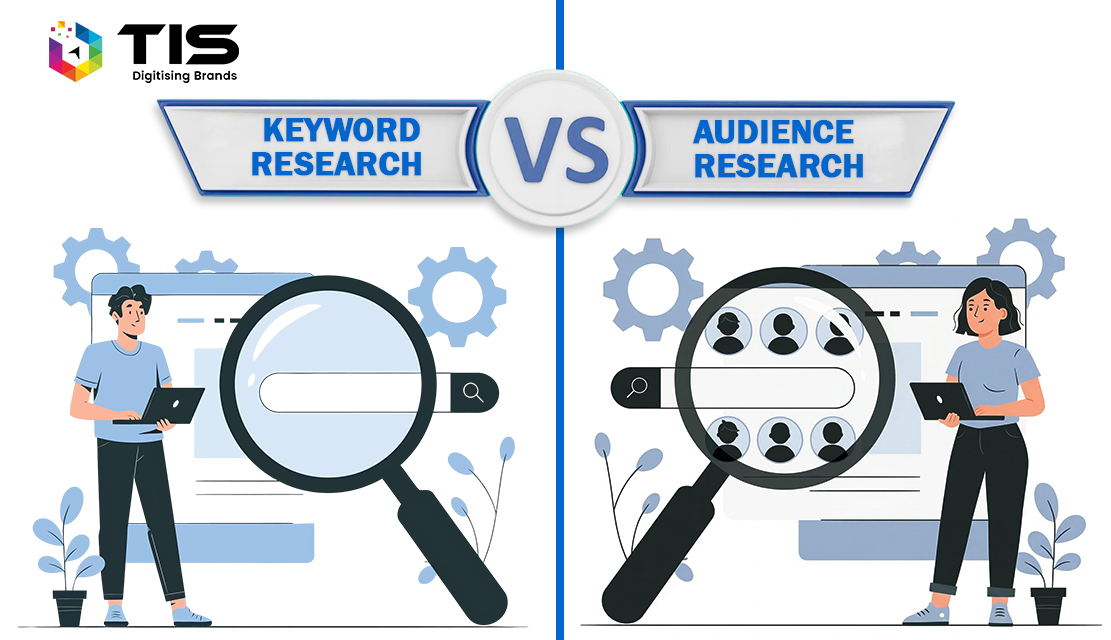
Your SEO strategy is responsible for traffic. Your content is ranked for targeted keywords. From analytics, we have consistent visitor growth. Yet conversion rates stall below projections, bounce rates are well above industry benchmarks and leads generated through organic search require serious qualification before they enter meaningful sales conversations. The divide between visibility and business value points to something that is missing from your content strategy at the fundamental level – not in execution, but in the research foundation that goes into determining what you’re going to create.
This gap is based on the fact that keyword research and audience research were equated, because they answer fundamentally different strategic questions. Keyword research tells us what people are searching — what search terms are typed directly into search engines. Audience research reveals the reasons for people to search-the problems, constraints, decision criteria, and business contexts that drive people’s search. Most content strategies focus on keyword volume, rather than on audience understanding to develop technically optimised content that ranks, but doesn’t convert because it answers the search query, but not the business problems that search queries represent.
Understanding the strategic distinction between keyword and audience research – and more importantly, how the two come together to inform content that both ranks and converts – is the difference between SEO traffic generated and revenue generated.
Keyword research is the process of identifying specific search terms that potential customers use when searching for information, solutions, or products related to your business. The process involves searching, analysis of search volumes, levels of competition, ranking difficulty, and search trends to determine which search terms represent viable ranking opportunities.
Key Keyword Research Elements:
Search volume shows how many monthly searches each keyword receives in order to provide demand signals. Competition metrics show how many websites are targeting the same terms and their domain authority, which sets their difficulty levels. Search intent classification categorises informational searches about knowledge gathering, commercial searches to understand evaluation and transactional searches to buy. Keyword variations capture related terms, synonyms and long-tail phrases add to the coverage without developing separate strategies.
What Keyword Research Tells Us:
Demand patterns reveal what topics are consistently of interest to the searcher compared to seasonal patterns of interest. Competitive landscape analysis highlights gaps where the competitors have a strong ranking and opportunities where the coverage is weak. Search language patterns show how different segments of the audience describe the same problems using different terminology. Technical buyers prefer industry jargon, and business buyers prefer outcome-focused language.
Keyword Research Limitations:
Volume metrics are a measure of search frequency and do not tell us anything about the searcher’s seniority, role, budget authority or decision-stage. Keyword tools report “enterprise software implementation” produces 2,400 searches a month, but cannot tell if searchers are consultants researching for clients, employees assigned preliminary research or executives evaluating vendors. Search intent classification offers direction but reduces complexity in buyer journeys because of the reality that often different people may perform informational, commercial and transactional searches sequentially.
The basic limitation of keyword research is about answering what people type, not who is typing it and why some searches are relevant to their business decisions.
Audience research is a study of the people behind searches – their business context, decision criteria, pain points, budget, evaluation processes and success metrics. Rather than the starting point for audience research being search volumes, it begins with understanding your customers and prospects to a depth sufficient for you to predict what they’re asking even before the keyword tools reveal it to you.
Elements of Core Audience Research:
Demographic and firmographic data determine who your audience consists of – job titles, seniority levels, company sizes, industries, and geographic locations. Psychographic information can tell us how audiences think – what their priorities, concerns, risk tolerance, decision-making styles, and communication preferences are. Behavioural patterns reveal information on how audiences research – which channels they trust, what formats of content they prefer, how much information they need, and what timelines they normally evaluate on.
What Audience Research Tells Us:
Problem hierarchies illustrate which problems audiences are more concerned with than others, and what pain points lead to active engagement in finding solutions or passive engagement in awareness. Decision processes make it clear who is involved in decisions, who has the power of the purse, according to what criteria decisions are made, and what objections always arise. Language patterns show how audiences internalise problems versus the ways they search externally – what they tell colleagues is different from what they type into Google.
Audience Research Sources:
Customer interviews give you the unfiltered insight into actual decision journeys, evaluation criteria, and the content that influenced purchases. Sales team intelligence is used to aggregate patterns from hundreds of prospect conversations to reveal common questions, misconceptions, and deal acceleration or deceleration factors. Support ticket analysis uncovers repetitive confusion points, feature requests and implementation difficulties that signify content lacunae. Competitor review mining helps to understand what the customers value in solutions, what the benefits that resonate most strongly are, and what the concerns that are most common.
Beyond Search Volume:
Audience research opens up avenues to valuable content opportunities with zero or minimal search volume because you know the problems audiences face, but have yet to learn to articulate them through search queries. A SaaS company learns through customer interviews that the implementation timeline is a concern that kills deals, but “enterprise SaaS implementation timeline” only receives 40 monthly searches. Creating comprehensive implementation timeline content brings in the prospects for even a little search traffic because it addresses the real decision barrier.
The question isn’t which research method is more important-it’s how to integrate both strategically to make content rank for relevant searches and convert qualified visitors into leads.
Sequential Approach to Research:
Start with audience research to establish a baseline of understanding who your audience is, what problems they have, how they make decisions, and what types of content influence them. Use audience insights to inform keyword research targeting – instead of going after high-volume keywords regardless of their relevance, focus on keywords that your ideal customer personas actually search as they make their evaluation journey. Validate keyword opportunities against audience criteria: does this search term tell you that this person is at the right company size, with the right problem, at the right decision stage? Layer audience language patterns onto keyword targeting to find semantic variations that semantic analysis tools miss- if customer interviews show prospects are saying “team scaling challenges” but your keyword tools only show “hiring problems,” target both.
Content Development from the Audience:
Use keyword research to understand which topics to write about and how to structure content to be visible in search results. Use the audience research to figure out how to address those topics. This includes depth of technical detail, business context needed, objections to preemptively handle, examples that resonate, and outcomes to emphasise. A keyword tool may suggest “marketing automation platforms” will generate search volume, but based on audience research, enterprise buyers are interested in integration complexity, risks of data migration, and ROI timeframes – all of which keyword tools cannot surface.
Avoiding Common Strategy Mistakes:
Many organisations make these integration errors. Keyword-first content creation creates articles that are optimised for ranking and read like keyword-stuffed SEO exercises instead of helpful resources solving problems. Audience-only content fails to consider search discovery at all and produces ideal content for target audiences who never discover the content because consideration was not given to search visibility. False binary thinking views keyword and audience research as competing alternatives as opposed to complementary inputs for the different aspects of strategy. Scale over relevance favours high-volume keywords that attract traffic that is a wrong fit and creates high-volume metrics with no qualified leads.
Executing comprehensive audience research and systematic keyword targeting across dozens and hundreds of content pieces is an area where dedicated expertise and specialised tools are mandatory. Organisations are left struggling with the need to balance the depth of the content with the speed of production, with the need to publish content to achieve either ranking or conversion opportunities, either in terms of inadequate keyword targeting or the other in terms of superficial understanding of the audience.
Professional SEO Agency in India services integrate both research methods into unified content strategies that generate visibility and revenue. Strategic SEO Services in Delhi NCR combine technical optimisation expertise with audience intelligence gathering, ensuring content ranks for commercially valuable searches while addressing actual business problems driving those queries. For organisations that are looking for content strategies that offer both organic traffic growth and lead generation efficiency, professional SEO services offer the depth of research and integration methodology needed to provide sustained results.
The difference between keyword research and audience research is the difference between ranking content and converting content. Keyword research tells you what people are searching for and gives you the words to be seen. Audience research answers the question of who is searching, why they are looking to buy, and what will motivate them to take action. On their own, neither is meaningful in delivering results.
High-performing content strategies are a combination of both. They begin with audience insight to determine which keywords are really important, then devise search-optimised content to solve real business problems behind these searches. Success is measured not in terms of traffic and rankings but in terms of the quality of the lead, conversions, and impact on revenue.
Effective SEO demands the science of keywords to be findable, and the art of understanding audiences to be relevant. The brands that perform better online aren’t publishing more content – they’re publishing content informed by what their audience is searching for and why it is relevant to the business.
 C - 81C, Sector - 8, Noida 201301, India
  info@tisindia.com
  (+91) 9811747579
1025 Beamon Drive, Franklin 37064 Tennessee, USA
info@tisindia.com
+1 424 283 4688
Sveavagen 34 111 34 Stockholm, Sweden
info@tisindia.com
A-10, Sahastradhara Rd, Doon IT Park, Dehradun, Uttarakhand
info@tisindia.com
(+91) 9811747579
(+91) 9811747579
1025 Beamon Drive, Franklin 37064 Tennessee, USA
info@tisindia.com
+1 424 283 4688
Sveavagen 34 111 34 Stockholm, Sweden
info@tisindia.com
A-10, Sahastradhara Rd, Doon IT Park, Dehradun, Uttarakhand
info@tisindia.com
(+91) 9811747579 
© 2026 TIS. All rights reserved.