
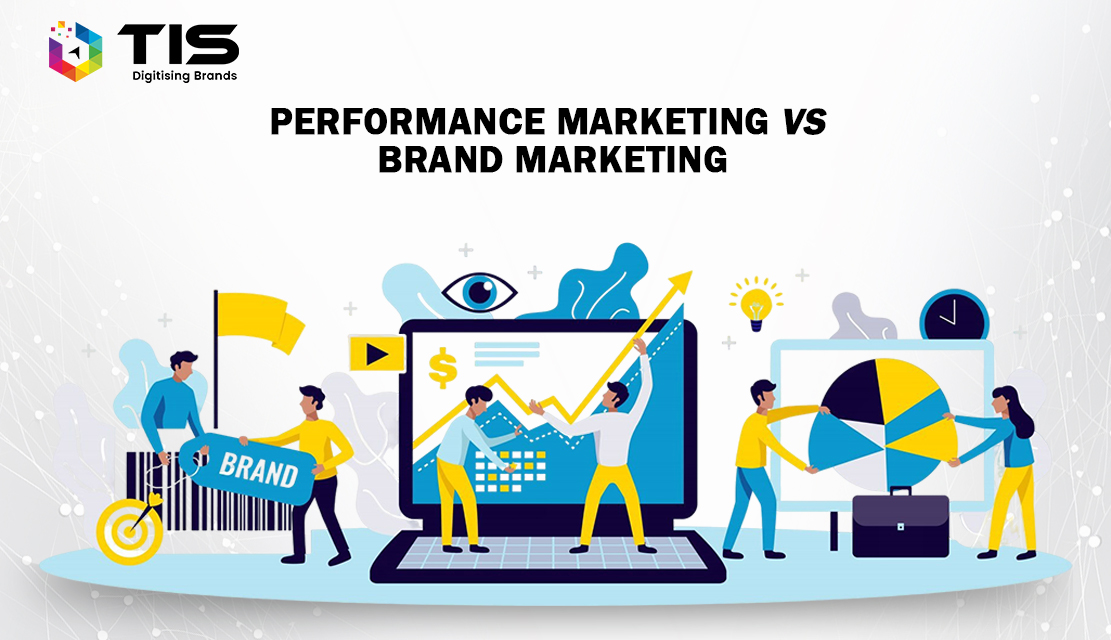
Your marketing budget is your driver of measurable results. Performance campaigns lead to leads, conversions through optimised funnel flows, and ROI calculation justifies every rupee spent on paid advertising. Yet customer acquisition costs escalate quarter-on-quarter, conversion levels level off in spite of higher spending, and competitors with smaller budgets somehow get away with charging premium prices while your discounts don’t help you gain market share. Something basic disconnects effort and sustainable growth.
This pattern results from the consideration of performance marketing and brand marketing as competing budget priorities rather than complementary strategies to meet different but equally important business objectives. Performance marketing is about harvesting existing demand–taking people who are already looking for a solution. Brand marketing generates future demand -awareness, preference, trust, and makes performance campaigns more efficient over time. Organisations that focus on one to the exclusion of the other sacrifice either immediate revenue or sustainable growth; while organisations that combine both strategically achieve consistent results compounding across quarters.
The challenge isn’t whether to do performance or branding in marketing. It’s understanding when each is the most important, how each amplifies the other, and what the balance is that brings about both immediate conversions and long-term competitive advantage.
Performance marketing includes strategies that are optimised for measurable, immediate actions – clicks, leads, purchases, app installs, form submissions. Every rupee that is spent has a direct connection to specific results, and success is measured by cost per acquisition, return on ad spend, conversion rates and quality of leads.
Core Performance Marketing Characteristics:
Precision targeting allows targeting specific segments of the audience based on demographics, behaviours, interests and purchase intent. Real-time optimisation makes changes to campaigns on the fly based on performance data – stopping the poor-performing ads, scaling the successful variations, and testing new campaigns quickly. Attribution tracking is the process of linking marketing touchpoints with conversion, in order to see which channels and campaigns are driving real business results. Bottom-funnel focus is about not creating initial awareness, it is about converting existing intent.
Performance Marketing Strengths:
Measurability gives concrete justification of ROI for each marketing rupee spent. Speed brings results in days or weeks and not months. Agility makes it possible to test and iterate fast based on performance data. Efficiency optimises the conversions of the existing demand with continuous optimisation.
Performances Marketing Shortcomings:
Diminishing returns are felt as you squeeze the last drops of existing demand pools to look for your solutions. Rising costs arise when competition becomes strong for the same audience segments. Discount dependency occurs when performance campaigns are based on promotion to drive conversions. Limited differentiation is possible due to optimisation of performance, often leading to similar tactics across competitors.
Performance marketing is great at harvesting demand and is poor at creating it. The truth is that when no one is looking for your category, performance campaigns find no one to convert.
Brand marketing is concerned with building durable associations, emotional associations, and mental availability that will make your brand the natural choice when purchase decisions need to be made. Rather than immediate conversions, brand marketing creates equity, building up month by month, year by year, awareness, consideration, preference, and loyalty that add up in competitive advantage.
Key Brand Marketing Characteristics:
Broad reach targets total addressable markets and not only in-market buyers who are actively seeking solutions. Emotional connection invokes preference in addition to rational comparisons of features through storytelling, values alignment and aspirational positioning. Consistent presence creates visibility at multiple touchpoints, which creates familiarity over time. Top funnel focus is about introducing your brand to people before purchase intent is formed.
Brand Marketing Strengths:
Demand creation helps to broaden your addressable market by making people aware of a need to which they are not yet conscious. Premium positioning allows for the ability to charge for the brand when there are more powerful brands that will command more than functionally similar brand alternatives. Performance efficiency increases since brand recognition improves click-through rates and conversion rates on performance campaigns. Unlike performance tactics that require continuous spending, sustainable growth comes into being through building brand equity over time.
Brand Marketing Challenges:
Measurement complexity links investment in the brand and revenue, challenging compared with the attribution of performance campaigns. Delayed results require patience as building brand equity occurs gradually rather than generating immediate conversions. Executive scepticism sets in when brand spending is not accompanied by the direct ROI calculations that performance marketing offers. Resource intensity requires a lot of budget and creative investment to create a meaningful brand presence.
Brand marketing sets up the conditions to make performance marketing work, but has difficulty in proving immediate ROI that justifies continued investment.
The best trade-off between performance and brand marketing varies according to the stage of the business, the competitive and market maturity. Understanding the time to make each approach a priority helps avoid the common errors that cost either short-term revenues or long-term viability.
Business Stage Considerations:
Early-stage startups generally spend primarily on performance marketing to capture all the existing demand and establish a presence in the market. Growth stage businesses transition to more performance as they balance between scaling, acquisition and building brand recognition, expanding addressable markets. Mature brands decrease performancas established brand equity enables campaigns to be more efficient, requiring less spending to sustain conversion volumes. Market leaders spend on performance and most of their budgets on brand building to keep their position as the leader in the category.
Market Context Factors:
High competition markets need stronger brand differentiation as performance campaigns alone cannot overcome commoditisation. Low awareness categories require investment in your brand to educate markets of the problems your solution solves before performance campaigns find in-market buyers. Saturated demand pools are signals of the need for brand marketing to create new demand when existing pools are exhausted through intensive performance marketing. Economic uncertainty often means more performance-oriented focus to achieve short-term revenue gains while budgets for brand spend are slashed – a trend which devours long-term positioning for short-term survival.
Common Balance Mistakes:
All-performance focus achieves high initial growth but reaches plateaus due to increasing customer acquisition costs and existing demand reaching limits. A brand-only approach results in beautiful positioning but no revenue to keep operations running or demonstrate the viability of the business. Siloed execution separates brand and performance as two teams with different objectives instead of integrated strategies that amplify each other. Reactive shifting goes from one approach to another depending on pressures each quarter, instead of strategic planning accounting for both timeframes.
Strategic integration assures that brand and performance marketing are used to enhance rather than compete with each making the other more effective.
Budget Allocation Framework:
Research suggests brand and performance provides the optimum balance for most businesses, though this varies depending on your business stage and market conditions. Rather than set percentages, set ranges that allow for tactical flexibility within strategic guard rails. Review allocation quarterly based on performance data, brand tracking and competitive dynamics rather than arbitrary annual planning.
Campaign Integration Strategies:
Infuse brand elements in performance campaigns. Maintaining brand consistency in performance-focused ads by using consistent visual identity, messaging themes and value propositions will keep the brand cohesive. Extend brand campaigns with performance activation – following wide-reach brand awareness with targeted performance campaigns capturing intent generated. Test brand impact on performance metrics–casual conversion rate testing, comparing people with brand exposure to cold audiences, allows for the quantification of brand value. Unified measurement tracks both immediate performance measures and longer-term brand health measures, providing a complete picture.
Organizational Alignment:
Shared objectives help ensure that the brand and performance team are working toward common business objectives, and not optimising separate metrics. Collaborative planning combines both approaches from strategy development, through the execution and measurement. Cross-functional learning sharing learning between teams – performance data informing brand strategy, brand research informing performance targeting. Unified reporting displays both performance ROI as well as brand equity growth, displaying complementary value.
Developing integrated strategies that balance immediate performance with long-term, cumulative brand building requires expertise from both disciplines – understanding the mechanics of optimising performance while appreciating the cumulative impact of brand building. Organisations have trouble implementing this balance when teams focus on optimising separate measures without strategic coordination, or when pressure from leadership encourages a short-term focus at the cost of sustainable positioning.
Professional digital marketing services provide integrated strategic frameworks, ensuring performance and brand marketing amplify each other effectively. As an experienced digital marketing company in India our team combines performance optimisation expertise with brand strategy capabilities, creating unified approaches that deliver both immediate conversions and compounding brand equity. For businesses seeking marketing strategies generating consistent results across quarters while building sustainable competitive advantage, our services offer the strategic depth and execution excellence required.
Performance and brand marketing don’t compete for budget – they work best together. Performance marketing captures existing demand and delivers fast, measurable results. Brand marketing develops future demands, builds equity, and makes performance campaigns more effective.
The real question isn’t which to invest in; it is how to integrate both. Early-stage businesses tend to over-rely on performance until costs are at their peak; established brands tend to focus on brand (rather than converting awareness into revenue). Both have growth left on the table.
Sustainable growth derived from balance: short-term revenue driving long-term brand building, and strong brand equity driving performance efficiency. Integrating both strategically and marketing becomes a growth engine – not just a cost.
 C - 81C, Sector - 8, Noida 201301, India
  info@tisindia.com
  (+91) 9811747579
1025 Beamon Drive, Franklin 37064 Tennessee, USA
info@tisindia.com
+1 424 283 4688
Sveavagen 34 111 34 Stockholm, Sweden
info@tisindia.com
A-10, Sahastradhara Rd, Doon IT Park, Dehradun, Uttarakhand
info@tisindia.com
(+91) 9811747579
(+91) 9811747579
1025 Beamon Drive, Franklin 37064 Tennessee, USA
info@tisindia.com
+1 424 283 4688
Sveavagen 34 111 34 Stockholm, Sweden
info@tisindia.com
A-10, Sahastradhara Rd, Doon IT Park, Dehradun, Uttarakhand
info@tisindia.com
(+91) 9811747579 
© 2026 TIS. All rights reserved.