
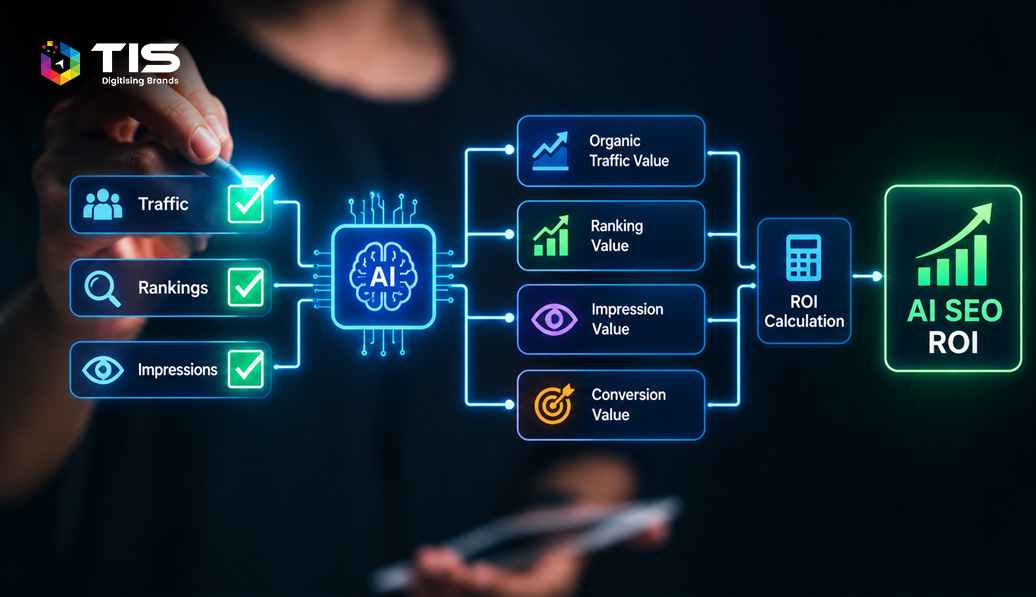
For over a decade, SEO ROI followed a simple chain: rankings created impressions, impressions produced clicks, clicks generated pipeline. That chain has fractured. Impressions can climb while clicks fall. Rankings can hold while sessions collapse. A page can influence a purchase without ever appearing in Google Analytics. If your reporting still ties ROI to traffic volume, you are almost certainly under-reporting the return on your AI SEO investment and over-attributing losses to underperformance. This blog explains how to recalculate AI SEO ROI when the three headline metrics no longer move together, and how to build a measurement model your CFO will actually trust.
The traffic-based ROI model assumed users click through to your site. That assumption no longer holds. AI Overviews, ChatGPT, Perplexity, Gemini, and Claude answer questions inside their own interfaces, and users often act on those answers without a single click landing in your analytics.
The scale of this shift is documented. SparkToro reports that 68% of U.S. Google searches now end without a click to any external site, and that number climbs to 83% when an AI Overview is present. First Page Sage found that AI Overviews reduce organic clicks by 58.6% on affected queries, cutting page performance from 87 clicks per thousand impressions to 36. Meanwhile, Gartner projected a 25% decline in traditional search engine volume by 2026 as users shift to AI assistants.
The result is a measurement gap. Your best-performing content in AI answers may show flat traffic in GA4 and stable rankings in Search Console, while quietly influencing thousands of purchase decisions you cannot see.
A defensible AI SEO ROI calculation now depends on four connected inputs rather than one traffic number.
The revised formula:
AI SEO ROI = (Attributed Revenue + Assisted Revenue + Brand Lift Value) − Total Investment
÷ Total Investment × 100
Each variable pulls from a different measurement layer. Attributed revenue still comes from GA4 or your CRM. Assisted revenue captures conversions influenced by AI citations before a user reaches your site directly. Brand lift value converts impression-only exposure into a comparable financial figure using branded search demand and share of model.
Citation share measures how often your brand appears in AI-generated answers for a defined query set across ChatGPT, Perplexity, Gemini, Claude, and Google AI Overviews. It replaces keyword rank as the primary visibility signal. A page cited in 40% of relevant AI answers is delivering ROI even if its organic sessions dropped 30% year over year.
Traffic that does arrive from AI assistants converts at meaningfully higher rates. First Page Sage recorded ChatGPT-referred visitors converting to leads at 4.7% against 1.9% for Google organic, roughly 2.5 times higher. Track AI referral conversion rate separately from organic in GA4 by segmenting known AI hostnames such as chat.openai.com, perplexity.ai, and gemini.google.com.
When users read your content inside an AI answer without clicking, many later search your brand name directly. A rising branded search curve alongside falling non-branded traffic is a leading indicator of AI visibility paying off. Compare month-over-month branded impressions in Search Console against your GEO investment timeline.
Sales conversations increasingly begin with a prospect saying they found you through ChatGPT or Gemini. Add a source field to demo request forms and CRM records. Multi-touch attribution should credit AI-cited content with assist value even when the last click was direct or paid.
| Measurement Layer | Traditional SEO ROI | AI SEO ROI (2026) |
| Primary visibility KPI | Keyword ranking position | Citation share across AI engines |
| Traffic assumption | Higher rank equals more clicks | Higher citation equals more influenced decisions |
| Conversion tracking | Last-click via GA4 | Multi-touch plus AI referral segmentation |
| Brand impact | Rarely quantified | Branded search lift and share of model |
| Reporting cadence | Monthly rank and traffic reports | Weekly citation audits plus quarterly ROI review |
Attribution without clicks sounds like guesswork. It does not have to be. Three practical methods make AI-influenced revenue defensible:
None of these give perfect precision. Combined, they produce a range that is defensible in a board meeting and directionally correct within 10 to 15%. That level of accuracy is enough for budget decisions, and it is closer to reality than the false precision of a last-click model that ignores everything happening inside AI interfaces.
Enterprise teams often add a fourth layer: cohort analysis comparing customer lifetime value between AI-referred and organic-referred accounts over a full year. Early data from our client portfolio shows AI-sourced customers producing higher expansion revenue in the first twelve months, likely because they arrive with stronger product understanding. That LTV differential should factor into ROI calculations for any subscription or contract-based business model.
AI SEO ROI is not uniform. It varies with how much of your buyer journey happens in AI answers versus on your site. B2B SaaS, enterprise services, and financial products see the strongest citation-to-pipeline correlation because buyers use AI assistants heavily during the research phase and still visit vendor sites before purchase. Healthcare, legal, and financial services see high branded search lift as users verify AI-cited information through direct navigation.
eCommerce shows a more mixed pattern. Transactional queries with clear buying intent still click through to product pages, so traffic-based ROI remains partly valid. Informational queries higher in the funnel now resolve inside AI Overviews, which shifts the value into brand and category awareness rather than direct sessions. Local services, where map results dominate, have felt the least disruption so far because proximity and reviews remain human decisions AI has not yet automated.
The practical takeaway is to weight the four ROI inputs differently by industry. A SaaS provider should weight citation share and assisted revenue heavily. A retailer should weight AI referral conversion rate. A local service business should still track traditional metrics as the primary signal while monitoring AI visibility as an early warning system for future shifts.
Even well-run programs miscalculate ROI when they carry over habits from the traffic era.
Traffic, rankings, and impressions were never the goal. They were proxies for influence. In 2026, those proxies are broken, and clinging to them produces two wrong conclusions at once: that successful AI SEO programs are failing, and that failing traditional programs are still working. The fix is not more dashboards. It is a smaller, sharper set of metrics tied to how buyers actually discover, evaluate, and choose.
TIS builds AI SEO measurement systems that quantify citation share, AI referral value, and brand lift alongside conventional SEO metrics, so growth is defensible to finance teams and boards. Explore our AI SEO services, Generative Engine Optimization services, and Answer Engine Optimization services to see how the measurement model is built and applied.
Research stage: Download our AI SEO measurement framework to benchmark your current reporting.
Evaluation stage: Book a 30-minute audit with a TIS strategist to identify where your current ROI model is under-reporting AI-driven revenue.
Decision stage: Engage TIS to design and implement a full AI SEO ROI reporting stack tied to your CRM and pipeline data.
For a companion piece on the tracking layer that feeds this ROI model, read How Brands Can Track AI Citations Across ChatGPT, Gemini, and Perplexity.
AI Overviews and assistants answer many queries inside the search interface, so users see your content without clicking through. Rankings can stay high while clicks fall because the answer is consumed on the results page. Impressions may even rise as your content gets pulled into AI summaries, but that visibility no longer converts into sessions your analytics can measure directly.
Combine four inputs: attributed revenue from GA4 and CRM, assisted revenue from AI-influenced conversions, brand lift value derived from branded search growth, and total investment across content, technical, and tooling costs. Subtract investment from combined revenue, divide by investment, and multiply by 100. This produces a defensible ROI figure that accounts for zero-click influence rather than relying only on tracked sessions your analytics platform can see.
Prioritize citation share across AI engines, AI referral conversion rate, branded search lift, and pipeline influence flagged in sales conversations. These four capture the value your content delivers when clicks no longer reflect reach. If citation share and branded search are climbing while traffic dips, your AI SEO program is working and the drop is a channel shift, not underperformance.
AI referral traffic comes from users who click a citation inside ChatGPT, Perplexity, Gemini, or Claude after reading part of your content within the AI answer. These visitors arrive pre-qualified, spend longer on site, and convert at rates roughly two to three times higher than standard Google organic sessions. Segment them by referrer hostname in GA4 to enable accurate performance comparison and revenue attribution.
Yes, but the investment mix shifts. Content, entity SEO, and structured data still influence which sources AI engines cite, so being cited requires being technically strong. What changes is measurement and content shape. Programs that align with generative and answer engine optimization principles capture higher-value traffic and brand influence, even when raw click volume from informational queries continues to decline.
Initial citation visibility often appears within two to eight weeks of publishing AI-optimized content and fixing technical foundations. Measurable pipeline influence typically takes 60 to 90 days as branded search lifts and sales teams begin logging AI-sourced leads. Full ROI validation, tied to closed revenue, generally takes two to three quarters, which matches or beats the timeline of traditional SEO programs.

© 2026 TIS. All rights reserved.