
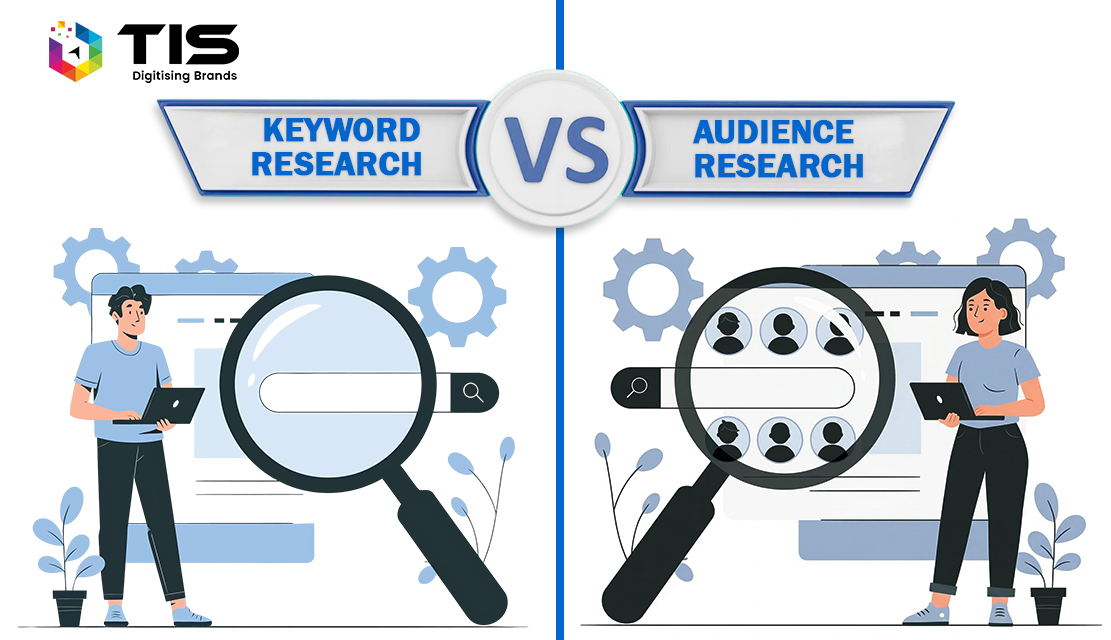
Most SEO programs still begin with a spreadsheet of search terms, monthly volumes, and difficulty scores. That approach builds traffic, but it rarely builds pipeline. The reason is simple. Keyword research tells you what people type into a search bar. Audience research tells you who those people are, why they searched, and what they need to read before they buy. Treating the two as the same discipline produces content that ranks for queries your buyers never make. This guide breaks down the difference, the overlap, and how B2B teams should sequence both to build content that earns rankings and revenue.
Keyword research is the practice of identifying the words and phrases people enter into search engines, then quantifying the demand, competition, and intent behind them. It is a supply-and-demand exercise. You learn which queries attract volume, which ones competitors already own, and which ones leave room for a new entrant.
The output is usually a ranked list of target terms tied to estimated monthly searches, keyword difficulty, SERP features, and intent categories such as informational, commercial, or transactional. Modern keyword tools also surface related questions, comparison queries, and entity-level topics that map to AI Overviews and answer engines.
Where keyword research falls short is in describing the searcher. A query like “enterprise CRM implementation” might be typed by a procurement manager, a junior analyst, a consultant scoping a client project, or a CIO comparing vendors. The volume number does not separate them. According to Google’s own helpful content guidance, content that ranks sustainably is written for a specific audience first, not for a search engine. Keyword data alone cannot supply that specificity.
Audience research is the practice of studying the people behind searches. It captures who they are, what business problems they face, what stage of the buying journey they occupy, and what evidence convinces them. Inputs include customer interviews, sales call recordings, support tickets, review mining, social listening, firmographic data, and analytics on existing readers.
The output is a layered picture of buyer personas, jobs to be done, decision criteria, objections, and the language each segment uses to describe the same problem. A technical buyer might call it “API latency.” A finance buyer calls the same issue “transaction delay impacting reconciliation.” Both queries deserve content, but the framing differs.
Audience research also exposes demand that keyword tools miss. New product categories, internal jargon, and emerging concerns often carry zero recorded search volume until a competitor publishes and captures the cluster. Gartner research on B2B buyer behavior shows that buyers spend the majority of their evaluation time on independent research, much of it on questions that never appear in standard keyword exports.
The table below summarizes how the two disciplines differ in scope, inputs, and strategic value.
| Dimension | Keyword Research | Audience Research |
|---|---|---|
| Core question | What are people searching for? | Who is searching and why? |
| Primary inputs | Search volume, SERP data, competitor rankings, keyword tools | Customer interviews, sales calls, reviews, CRM data, analytics |
| Output | Prioritized keyword and topic list | Personas, jobs to be done, objections, decision criteria |
| Strength | Quantifies demand and competition | Reveals intent, context, and unmet need |
| Weakness | Blind to the searcher’s role and stage | Harder to scale and quantify |
| Best used for | Topic prioritization, technical SEO, content gap analysis | Messaging, content angles, conversion design |
| Measurement | Rankings, impressions, organic sessions | Engaged sessions, qualified leads, pipeline influence |
Generative engines like ChatGPT, Gemini, Claude, and Perplexity no longer match queries to pages purely on keyword density. They synthesize answers from sources that demonstrate clear expertise on a defined audience problem. Pages built purely from keyword exports tend to read as generic summaries. They get crawled, but they rarely get cited in AI Overviews or LLM answers because they lack the specificity that retrieval systems reward.
Audience research changes that outcome. When content reflects the exact phrasing, constraints, and evaluation criteria a buyer uses, it becomes easier for an LLM to extract a clean, contextual passage to cite. The shift from ranking blue links to being chosen as a source rewards depth and audience fit over keyword saturation.
Treating keyword research and audience research as competing methods is a false choice. Mature B2B content programs sequence them deliberately. The pattern that works:
The most expensive errors usually come from over-relying on one input. Chasing high-volume keywords without an audience filter floods your site with readers who have no buying authority. Skipping keyword research entirely leaves your best content invisible to the search systems that would otherwise distribute it.
Other recurring mistakes include building personas from internal opinion rather than primary research, treating search intent as a fixed label when buyer journeys are non-linear, and measuring success on impressions instead of revenue contribution. Industry research on keyword strategy consistently shows that pages aligned to specific buyer intent outperform volume-led pages on conversion, even when they attract fewer total visitors.
At TIS, we build content programs that begin with audience definition and end with measurable pipeline. Our SEO services integrate keyword research, SERP intent analysis, and audience interviews into a single content strategy. For teams optimizing for generative engines, our generative engine optimization services extend the same framework to AI Overviews and LLM citations. Teams that prefer to dive deeper into AI search mechanics can also read our breakdown of how to create AI-readable content that ranks everywhere.
If your site already ranks for traffic but converts poorly, the gap is almost always on the audience side. Start with customer interviews and message mining before touching another keyword tool. If your site barely surfaces in search at all, the gap is on the discoverability side. Begin with SERP and keyword analysis, then layer audience insight as you scale. Most programs need both within ninety days. The order depends on which deficit is costing you more revenue today.
Neither is more important on its own. Audience research defines who you are writing for and what they need to decide. Keyword research defines how those people search for that need. A content program built only on keywords ranks for the wrong readers. A program built only on audience insight produces strong messaging that no one finds. The two work best as sequenced inputs into the same strategy.
No, but keyword research can act as a starting proxy when interview budgets are limited. Patterns in long-tail queries, related questions, and forum discussions reveal real audience concerns. Treat those signals as hypotheses, then validate them through short customer calls or sales team interviews. Even five conversations sharpen targeting more than another month of keyword exports. Skipping audience input entirely usually shows up later as low conversion rates.
Generative engines cite sources that answer a specific user problem in clear, self-contained passages. Audience research surfaces the exact problems, constraints, and language buyers use. Content built on that input naturally produces the direct, contextual answers that LLMs prefer to quote. Keyword data alone tends to produce generic explanations that AI systems summarize without citing. Audience depth is now a retrievability factor, not just a messaging one.
Useful inputs include CRM and sales call recordings, review platforms like G2 and Capterra, community forums such as Reddit and industry Slack groups, social listening tools, and analytics platforms that segment behavior by source and persona. Customer interviews remain the highest-value input. Tools accelerate pattern discovery, but the qualitative depth comes from direct conversations with buyers, prospects, and lapsed customers across each priority segment.
Keyword research should be revisited every quarter to catch shifts in search demand, new SERP features, and emerging AI Overview patterns. Audience research benefits from a deeper annual refresh, with lighter quarterly check-ins through sales feedback and review monitoring. Major product launches, market shifts, or expansion into a new segment should trigger an immediate refresh on both sides, since outdated inputs quickly produce content that misses current buyer reality.
 C - 81C, Sector - 8, Noida 201301, India
 info@tisindia.com
 (+91) 9811747579
1025 Beamon Drive, Franklin 37064 Tennessee, USA
info@tisindia.com
+1 424 283 4688
Sveavagen 34 111 34 Stockholm, Sweden
info@tisindia.com
A-10, Sahastradhara Rd, Doon IT Park, Dehradun, Uttarakhand
info@tisindia.com
(+91) 9811747579
(+91) 9811747579
1025 Beamon Drive, Franklin 37064 Tennessee, USA
info@tisindia.com
+1 424 283 4688
Sveavagen 34 111 34 Stockholm, Sweden
info@tisindia.com
A-10, Sahastradhara Rd, Doon IT Park, Dehradun, Uttarakhand
info@tisindia.com
(+91) 9811747579

© 2026 TIS. All rights reserved.