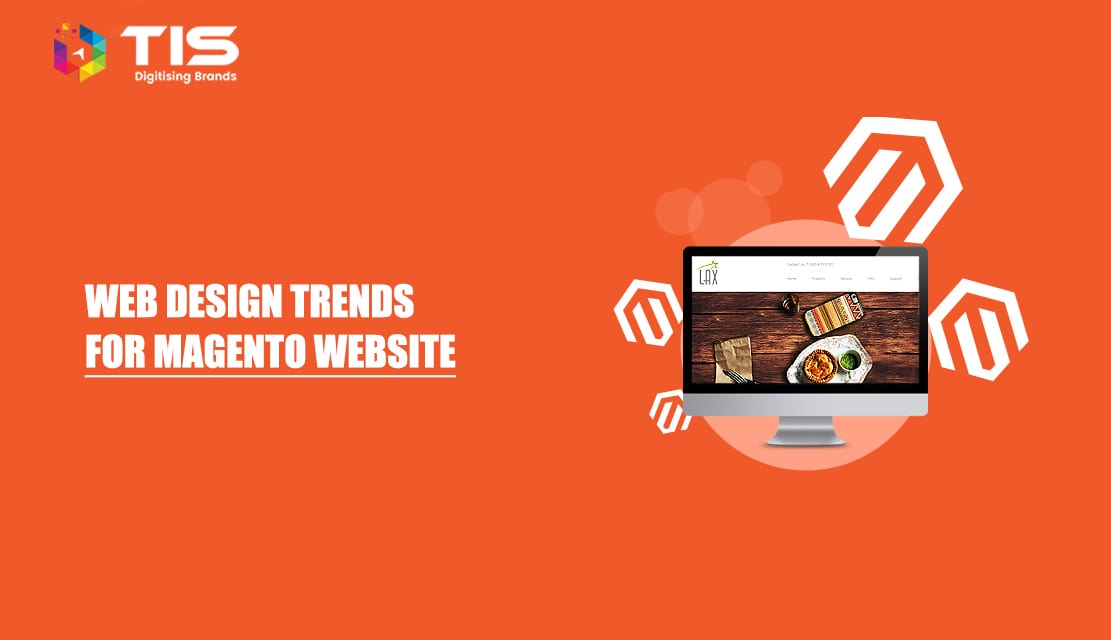
Are you one among those who think that e-commerce store features are the only thing which impacts the customers and boosts conversion? Well, that might be partially true! In order to attract customers and catch more eyes, it is equally necessary that your website looks modern and visually impressive. And this is when Magento comes to your rescue.
Magento with its inbuilt high-end features, speed, reliability, and scalability is the perfect platform to gear up an e-commerce store. It is easy to customize, and thus one can craft out a top-notch user experience with a minimalistic design. What else? There are various game-changing trends that you can vouch for!
Below are some of the best Magento Web Design you should look out for:
Full-screen background image sliders are not new! They have existed in this business for some time now and are now taking the world of design by storm. Full-screen background image sliders are perfect if you have a lot of features in your store and you want your customer to get through them on the first look. Sliders are eye catchy, and thus, showcasing the new offers and latest trends on them are sure to win hearts. Further, sliders keep your site clean. You must make the slider big so that it is noticeable, perhaps also a full screen so that you grab the attention of your visitors and turn your website to look beautiful and trendy.
So you are on an infinite scrolling e-commerce store and suddenly you need to check out the menu. What do you do? You require scrolling back to find the menu. Not anymore! Pinned or the sticky menu meets the purpose now. The main purpose of a sticky menu is to enhance navigation. Navigation is particularly important for an e-commerce store where there is already cut-throat competition. If the menu stays on the page constantly, the users can navigate through the web pages without delays and obstacles and that is truly great. What’s more? You can browse through TIS for an exemplification of a perfectly executed sticky main menu.
What are ghost buttons? These are empty transparent buttons that have a fundamental form. Such buttons are also often called hollow and empty buttons. Whatever the name may be, they look different when compared to standard colored buttons. A hollow button goes well with the theme of the website, and can easily catch visitors’ attention if it is strategically placed as far as position and background are concerned. These buttons are perfect for sites that have a flat or minimalist user interface, or also those which make use of the large-scale background photo.
White space generally just acts as a filler between elements of design. However, only a few notice that. Well, this so-called white space is actually an important element of design too. Compare it with a mortar between the bricks. White space is what focuses on enhancing the user experience, on the organization of the content and layout, and serves as a base for graphics and text.
However, you need not restrict your creativity with white space. You can opt for the colored background too. The only rule is that it should look visually attractive.
Web designs, these days have evolved to become micro-interactions. The perfect blend of HTML and CSS animation can boost the user experience manifold by making every element respond to the actions.
These hovers or animated effects come into action when a user hovers a mouse over a certain area. This then encourages the user to explore the website further.
You would also probably agree with the fact that a static layout might not create the same interest. Hence, animations on your site could prevent tedium, making the navigation simple yet thrilling. Titanyshop Magento theme is one of the perfect examples which implements Hover effects.
Illustrations are a web design trend that is all set to make a comeback. A good custom-drawn illustration would instantaneously put you apart from your contenders. Illustrations might not go well with every niche of business. But if you can use illustrations to define your niche, nothing like that! You can follow the present trends so that your website is designed uniquely. Bonobos.com exemplifies the perfect custom-drawn illustrations within its website.
Websites are no more just about providing a static user experience to the users. Dynamic content like images and videos is rocking the web, taking the web experience to an all-new level.
A background video can provide the depth to your website that you have been looking for. It is that key that can turn your site into something more impressive, interesting as well as remarkable. You can use a background video to demonstrate your products and services or how your product works or just to create a unique atmosphere and mood. You can also choose to display your products or narrate a story through background video which would not have been as fun and easy as with a common web page.
Undoubtedly, it is all about weaving stories that sell! Each design has its own story. To ensure that your story sells, it is necessary that you make use of user interface and visual designs for creating something that people would want to interact with. Nice stories are simple to tell. Good stories are always believable, emotional, and truthful. Whereas the best stories are great real stories that are valid and can have an impact on any audience.
The parallax scrolling effect is not new! It has been with us for quite some time now and is expected to stay for longer. Parallax is just a simple illusion wherein the background pictures move with the mouse, but slower than the foreground images. This creates an illusion of depth, thus catching the attention of users immediately. What more can one ask for?
Grid or card layouts have probably gained property with the advent of Pinterest, Twitter, and Facebook. The layout has become so popular that a lot of organizations are now swearing by it as their ultimate web design. The only reason is their neat layout which organizes everything perfectly at the same time giving the website a minimalistic clean look. They are not just pleasing visually, but also useful in terms of their utility.
These trends are really helpful in making your website a great experience for the users. However, you would not be technically sound enough to tactically use these trends. Hence, it is always better to hire a Magento web developer who can assist you in making a great website for you! Ask your Magento developer to pick the perfect Magento edition which goes well with your requirements
Magento web designing is an excellent platform for eCommerce development which offers a lot of advantages and features. You can build your eCommerce website with magento depending on your needs and requirements and your business category. It is the most flexible platform used to build websites which is super rich when it comes to offering quality and attributes.
This guide gives you an insight on the latest Magento web design trends of 2023. Using these ideas will help you to be at the top of your game and give your business a considerable growth.
 C - 81C, Sector - 8, Noida 201301, India
 info@tisindia.com
 (+91) 9811747579
1025 Beamon Drive, Franklin 37064 Tennessee, USA
info@tisindia.com
+1 424 283 4688
Sveavagen 34 111 34 Stockholm, Sweden
info@tisindia.com
A-10, Sahastradhara Rd, Doon IT Park, Dehradun, Uttarakhand
info@tisindia.com
(+91) 9811747579
(+91) 9811747579
1025 Beamon Drive, Franklin 37064 Tennessee, USA
info@tisindia.com
+1 424 283 4688
Sveavagen 34 111 34 Stockholm, Sweden
info@tisindia.com
A-10, Sahastradhara Rd, Doon IT Park, Dehradun, Uttarakhand
info@tisindia.com
(+91) 9811747579

© 2026 TIS. All rights reserved.