
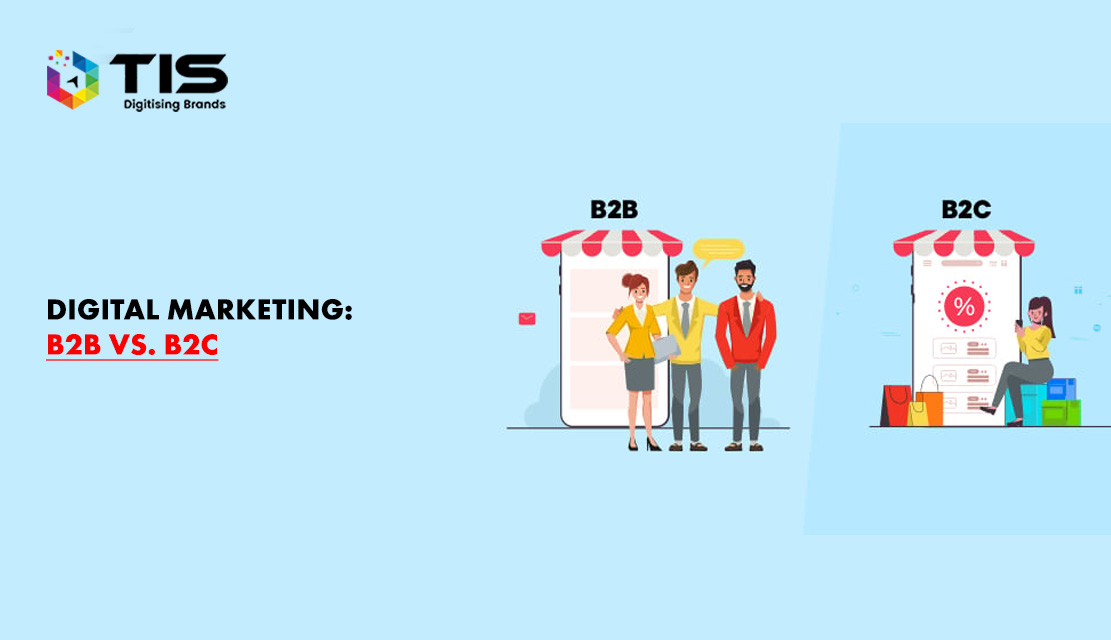
Marketing to a procurement committee is not the same job as marketing to a parent shopping on a phone at 9 p.m. The buyer is different, the risk is different, the timeline is different, and the metrics that prove success are different. Most teams still run B2B and B2C playbooks that look interchangeable on the surface, which is exactly why budgets leak and pipelines stall. This guide breaks down where B2B and B2C digital marketing diverge in 2026, where they have started to converge under AI search and personalization, and how to build a strategy that fits the way your buyers actually decide.
B2B digital marketing sells to organizations, where purchases are evaluated by committees against operational, financial, and risk criteria. B2C digital marketing sells to individuals, where purchases are shaped by personal need, emotion, convenience, and brand familiarity.
The structural gap is wider than most marketers assume. According to Gartner research on the B2B buying journey, the average B2B buying group includes six to ten decision-makers, and buyers spend only around 17 percent of their total purchase time meeting with potential suppliers. A consumer buying a pair of sneakers may decide in five minutes. An enterprise buying a CRM platform may take nine months and involve finance, IT, security, and three line-of-business owners.
That single difference cascades through every channel choice, content format, KPI, and CTA you build.
| Dimension | B2B Digital Marketing | B2C Digital Marketing |
|---|---|---|
| Buyer | Committee of 6 to 10 stakeholders across functions | Single individual, occasionally a household |
| Primary motivation | ROI, risk reduction, operational fit, compliance | Personal need, emotion, lifestyle alignment, price |
| Sales cycle | Weeks to 12+ months | Minutes to a few days |
| Average order value | High, recurring contracts common | Lower, transaction-led |
| Dominant channels | LinkedIn, search, email, webinars, review platforms | Instagram, TikTok, YouTube, paid social, retail search |
| Content emphasis | Whitepapers, case studies, ROI calculators, demos | Short video, UGC, influencer content, product visuals |
| Conversion goal | Qualified lead, demo, RFP, signed contract | Add to cart, checkout, subscription, repeat purchase |
| Primary KPIs | SQL volume, pipeline value, CAC, LTV, deal velocity | ROAS, conversion rate, AOV, retention, NPS |
B2B buyers spend most of their evaluation outside your sales conversation. Gartner reported in March 2026 that 67 percent of B2B buyers now prefer a rep-free experience, and 45 percent used AI tools during a recent purchase. They are not waiting for your demo, they are reading peer reviews, building internal business cases, and shaping requirements with their colleagues.
That means B2B content must do three jobs the consumer world rarely demands:
B2C buyers operate on a different axis. They are making purchases tied to identity, mood, social signaling, and convenience. Trust comes from familiarity, social proof, and a smooth checkout, not from a 22-slide ROI deck. Loss aversion shows up as cart abandonment, not as a procurement veto. The job of marketing is to compress hesitation, not to support a months-long internal sale.
The practical implication is that the same brand cannot use one tone, one funnel, or one creative template across both audiences. A B2B landing page packed with specifications would confuse a consumer, while a B2C-style hero image with one big button would fail to give an enterprise evaluation committee anything to chew on. Strategy has to start with the buyer and work backward to the channel.
B2B content strategy is account-aware. You are not writing for “the market,” you are writing for a CFO, a Head of Engineering, and a Director of Procurement who will all read different sections of the same evaluation. The channels that earn attention reflect that reality:
B2C strategy compresses attention into seconds. The buyer scrolls past hundreds of brands a day, so creative quality and timing carry the campaign:
Both models now share one battleground: AI-driven search. Whether a CIO is asking Perplexity to compare data platforms or a shopper is asking ChatGPT for the best running shoes for flat feet, the answer engine decides who gets cited. That has reshaped how SEO works for both audiences.
For B2B, ranking inside a Google AI Overview or being cited by an LLM is increasingly more valuable than ranking second on a traditional SERP. Buyers self-educate, and the source they trust during that phase often becomes the shortlist. For B2C, AI-driven product discovery is bypassing category pages entirely. If your product is not described in structured, machine-readable formats, it is invisible in conversational shopping.
This is where end-to-end digital marketing services need to integrate generative engine optimization with classical SEO, not treat them as separate disciplines. Brands that adapt their content for both keyword search and prompt-based discovery capture demand from both buyer types.
B2B marketing ROI ties directly to revenue, with attribution stretched across long, multi-touch journeys. A single closed deal can justify a quarter of marketing spend. B2C marketing ROI is measured across high-volume, lower-value transactions, where small lifts in conversion rate or average order value compound quickly.
The KPIs that matter look almost nothing alike:
Confusing the two is one of the most common reasons B2B teams overspend on awareness campaigns and B2C teams underinvest in retention. Choosing the right balance between brand and direct response is its own discipline, explored further in our guide on performance marketing vs brand marketing.
The cleanest distinctions are blurring. Three forces are pulling both models toward a shared center:
The point is not that the two models are merging, but that ignoring the other side’s discipline now leaves opportunity on the table. The strongest B2B brands tell human stories. The strongest B2C brands track LTV with the patience of an enterprise sales team. A SaaS company learning emotional storytelling from a beauty brand, or a DTC label learning cohort analysis from an enterprise team, is what modern advantage looks like.
TIS has spent 18+ years building digital marketing programs across both models, for clients in healthcare, fintech, retail, eCommerce, education, and enterprise services. The approach starts with one question: who is actually making the decision, and what does that person need to see, read, or trust before they act? From there, channel mix, content depth, and measurement frameworks are designed against that buyer reality, not against generic best practice.
For B2B clients, that often means combining account-based marketing, thought leadership, and AI-search-ready content. For B2C clients, it usually means creator-led campaigns, conversion rate optimization, and retention loops. For hybrid brands, it means both, run with shared analytics.
B2B digital marketing targets organizations where six to ten stakeholders evaluate purchases against ROI, risk, and operational fit. B2C digital marketing targets individuals who decide based on personal need, emotion, and convenience. The result is longer cycles, higher deal values, and more educational content in B2B, while B2C runs on speed, visual storytelling, and direct-response conversion within shorter buying windows across mobile-first channels.
B2B works best on LinkedIn, organic search, email nurture, webinars, and third-party review platforms because buyers research deeply before contacting vendors. B2C performs strongest on Instagram, TikTok, YouTube, paid social, and marketplace search, where attention is captured in seconds. The choice depends on where each buyer spends real research and discovery time, not on channel popularity in general industry rankings.
Yes. B2B SEO targets problem-stage and category-level queries with long-form, authoritative content designed to support self-directed research and AI-search citations. B2C SEO prioritizes transactional and product queries, structured data for shopping, and fast mobile experiences with strong visuals. Both now compete inside AI Overviews and LLM answers, so generative engine optimization is becoming essential for visibility across either model in 2026.
B2B cycles typically run from several weeks to over twelve months, depending on deal size, stakeholder count, and procurement rules. Gartner data shows buyers spend only about 17 percent of that time with sales reps. B2C cycles are far shorter, often minutes to a few days, since the buyer is usually one person and the purchase carries lower financial and organizational risk.
An experienced agency can handle both, but only if it builds separate strategy, content, and measurement frameworks for each. The buyer psychology, channel mix, and KPIs differ enough that reusing playbooks usually wastes budget. TIS structures B2B and B2C engagements with dedicated specialists, shared analytics infrastructure, and audience-specific creative, so each program performs against the metrics that matter for that model.
AI is reshaping both. In B2B, buyers use tools like ChatGPT and Perplexity to compare vendors before contacting sales, making citation-worthy content critical. In B2C, AI is influencing product discovery, personalization, and creative production at scale. The brands winning across both models invest in generative engine optimization, structured content, and AI-assisted personalization, while keeping human judgment in strategy and creative direction.
 C - 81C, Sector - 8, Noida 201301, India
 info@tisindia.com
 (+91) 9811747579
1025 Beamon Drive, Franklin 37064 Tennessee, USA
info@tisindia.com
+1 424 283 4688
Sveavagen 34 111 34 Stockholm, Sweden
info@tisindia.com
A-10, Sahastradhara Rd, Doon IT Park, Dehradun, Uttarakhand
info@tisindia.com
(+91) 9811747579
(+91) 9811747579
1025 Beamon Drive, Franklin 37064 Tennessee, USA
info@tisindia.com
+1 424 283 4688
Sveavagen 34 111 34 Stockholm, Sweden
info@tisindia.com
A-10, Sahastradhara Rd, Doon IT Park, Dehradun, Uttarakhand
info@tisindia.com
(+91) 9811747579

© 2026 TIS. All rights reserved.